How to Return Serve in Table Tennis: Read It, Then Beat It (2026)
 By Harshwardhan · Updated
In This Article
- Why Receiving Serve Feels So Hard (and How to Fix It)
- Step 1: Read the Spin Before the Ball Reaches You
- Step 2: Set Up a Receive Stance That Covers the Table
- Step 3: Judge the Length (Short, Half-Long or Long)
- How to Return Each Type of Serve
- Choosing Your Receive: Push, Drop Shot, Flick or Loop
- Common Receive Mistakes and How to Fix Them
- Drills to Improve Your Serve Return
- A Simple Receive Plan for Club Players
- Frequently Asked Questions
Why Receiving Serve Feels So Hard (and How to Fix It)
To return serve in table tennis, read the spin at the moment the server's racket meets the ball, judge whether the serve will land short or long, and then pick a matching return: push or flick short serves, and attack long serves with a loop or drive. Most missed returns are not technique failures. They are reading failures: the racket angle was right for a different spin.
The server has every advantage. They choose the spin, speed, length and placement, and they often hide which one is coming inside a similar-looking motion. Your job as the receiver is to neutralize that advantage, and ideally steal it. A good return does not need to be spectacular. It needs to land, stay low, and stop the server from attacking first.
Quick Facts
- The serve must bounce first: You may only return it after it has bounced once on your side
- The three reads: Spin, length (short, half-long or long) and placement
- Short serves: Usually pushed, dropped short or flicked
- Long serves: Usually looped or driven
- Golden rule: If you cannot read it, play a safe, controlled return rather than guessing hard
Step 1: Read the Spin Before the Ball Reaches You
Reading spin is the skill that separates players who return serve from players who just survive it. USA Table Tennis Hall of Fame coach Larry Hodges, writing for Butterfly, recommends focusing only on the moment of contact and ignoring the motion before and after it, since servers often add fake motions to disguise the real one. For the physics behind each spin, see our guide to table tennis spin.
Clue 1: The Racket Direction at Contact
The direction the racket travels as it brushes the ball tells you the spin type:
- Racket moves down and under the ball: backspin
- Racket moves up and over the ball: topspin
- Racket moves sideways across the ball: sidespin, often combined with a little backspin or topspin
- Racket moves forward with little brushing: likely no-spin (sometimes called a "dead" or "float" serve)
Racket speed matters as much as direction. A fast, grazing brush means heavy spin. A slow, flatter contact means light spin.
Clue 2: How the Ball Flies and Bounces
The ball confirms or corrects what you saw. In Hodges' description, backspin tends to float in the air and slow down after the bounce, topspin dips in the air and jumps forward low and fast off the table, and sidespin curves sideways at every stage. A no-spin ball does none of these things.
| Spin | Racket at Contact | In the Air | After the Bounce | If You Misread It |
|---|---|---|---|---|
| Backspin | Down and under | Floats | Slows, stays back | Your return goes into the net |
| Topspin | Up and over | Dips | Kicks forward, low and quick | Your return flies high or long |
| Sidespin | Across the ball | Curves sideways | Kicks sideways | Your return goes off the side |
| No-spin | Flat, little brush | Straight | Normal, predictable | Your push pops up |
Clue 3: The Logo on the Ball
On slower serves you can sometimes see the printed logo. If you can read it clearly, the ball is spinning slowly or not at all. A blurred logo or a visible stripe means heavy spin, and the angle of the stripe hints at the spin axis.
Step 2: Set Up a Receive Stance That Covers the Table
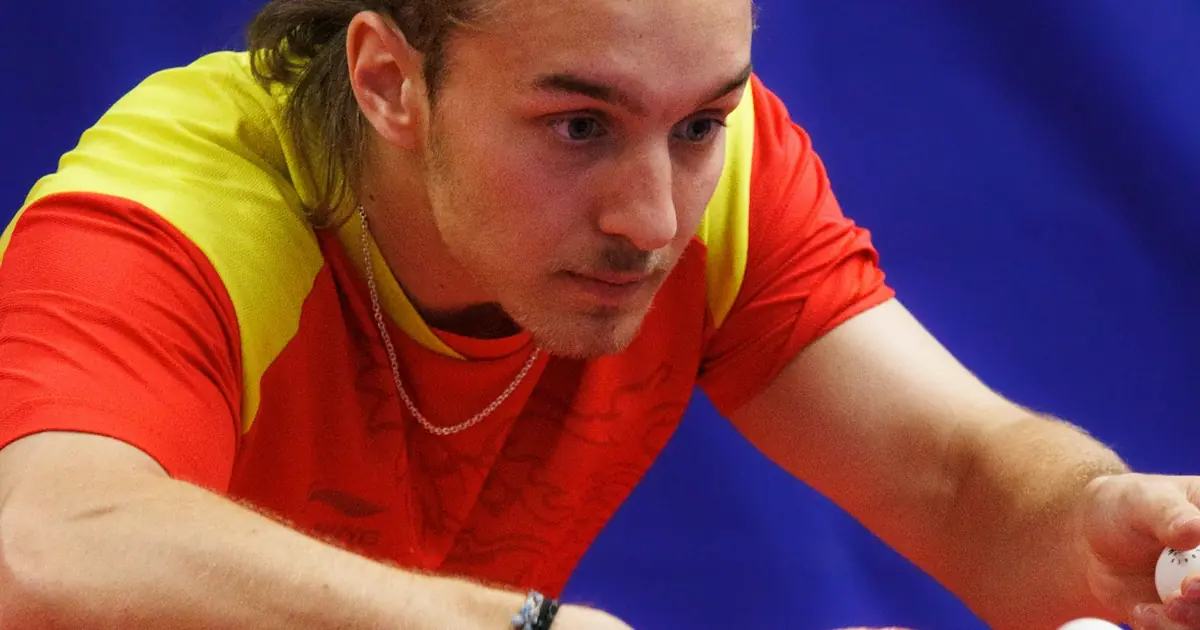
A good receive position lets you reach a short serve to your forehand and a fast long serve to your backhand from the same starting point. There is no single correct spot, but most coaches teach a similar base.
- Find your distance. Start roughly an arm's length behind the end line. Closer helps against short serves; a step back helps against fast long ones.
- Shade toward your backhand. Right-handers commonly stand nearer the backhand corner so the backhand covers that side and the forehand covers the rest. Left-handers mirror this.
- Get low and forward. Feet wider than shoulder width, knees bent, weight on the balls of your feet, leaning slightly forward.
- Hold the racket in front. Keep it above table height, roughly in the middle of your body, in a neutral position ready for either wing. A neutral grip helps here.
- Step in, then step back. Against short serves, step in with your playing-side foot under the table, play the shot, and recover straight back to your ready position.
Quick, small steps beat big lunges. If you often arrive late, our table tennis footwork guide covers the in-and-out movement used on receive.
Step 3: Judge the Length (Short, Half-Long or Long)
Length decides which strokes are available. A short serve would bounce twice on your side if you left it. A long serve would bounce once and go off the end. A half-long serve is the awkward one in between: its second bounce would land close to your end line.
- Short: You cannot take a full swing over the table, so you push, drop short or flick.
- Half-long: Decide early. If the ball will come out past the end line, loop it after it peaks. If not, treat it as short.
- Long: You have room for a full stroke. Attack whenever you can.
The first bounce gives it away. A first bounce close to the server's end line usually means a long serve; a first bounce close to the net usually means a short one.
How to Return Each Type of Serve
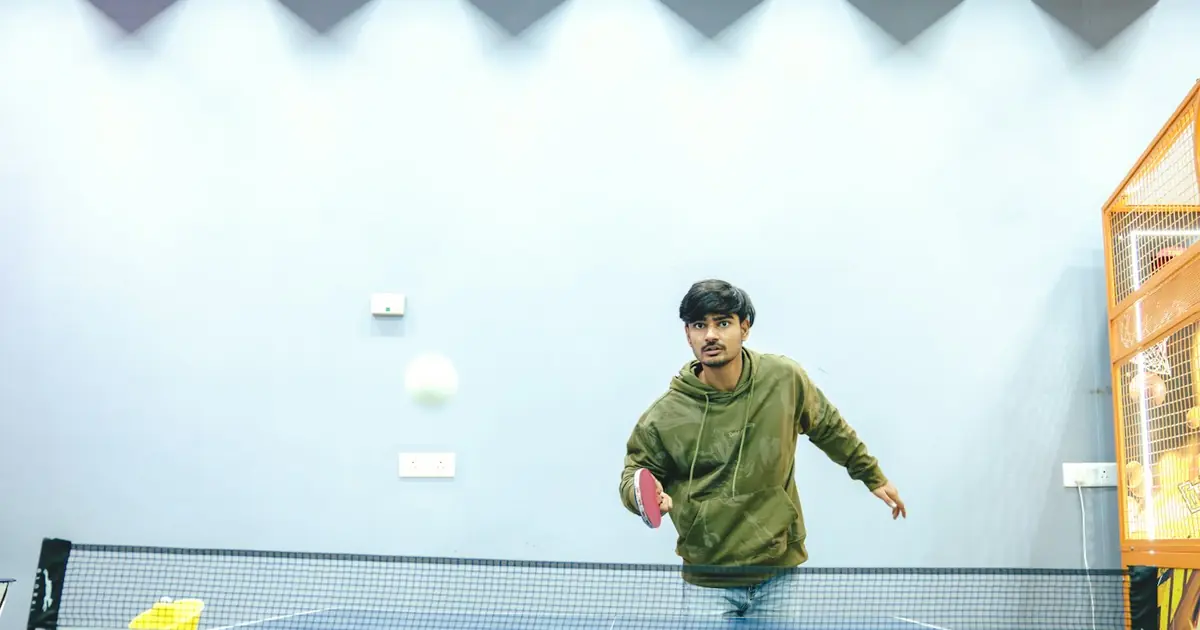
Once you have read spin and length, the choice of return becomes much simpler. Hodges' guidance for Butterfly sums up the general pattern: attack long serves, attack short topspin and sidespin serves, and vary your returns against short backspin and no-spin serves.
Returning Backspin Serves
Short backspin: You have three main options. A short push (also called a touch or drop shot) takes the ball early and drops it back short so the server cannot loop it. A long push drives the ball fast, low and deep, ideally wide or to the elbow. A flick attacks over the table with an open racket and a quick upward brush. Mix all three so the server cannot prepare. See our dedicated table tennis push and flick guides for the strokes themselves.
Long backspin: Loop it. Use more upward lift and a more open racket than you would against topspin, and brush the back of the ball. Players who cannot yet loop backspin can push it back, but that usually hands the server an easy attack. Our table tennis loop guide covers the stroke in detail.
Returning Topspin Serves
Short topspin: Do not push it. A push with an open racket against topspin tends to fly long or pop up. Instead, flick with a closed racket, or block it back with a firm, closed racket angle and place it wide.
Long topspin: Close the racket and attack with a loop or a drive, moving forward through the ball rather than lifting it. If you are rushed, a controlled block is a safe fallback.
Returning Sidespin Serves
Sidespin makes the ball jump off your racket in the direction the server's racket was traveling at contact. To compensate, aim toward the side the server's racket came from, or angle your racket to point that way. Hodges also suggests aiming slightly inside the corners, since sidespin will carry the ball outward.
Short sidespin: Flick it if you can, because flicking uses the sidespin rather than fighting it. If you push instead, push with heavy backspin of your own and aim away from the curve.
Long sidespin: Loop or drive it. Read which way it will curve after the bounce and give yourself a little extra room to that side.
Sidespin combined with backspin or topspin: Most real serves mix spins. Handle the backspin or topspin part with the open or closed angle, then adjust the aim for the sidespin part.
Returning No-Spin Serves
A no-spin serve is designed to look like backspin. If you push it with the open racket you would use against heavy backspin, the ball floats up high and gets smashed. Against a short no-spin serve, close the racket slightly and push firmly forward, drop it short, or flick it, since a no-spin ball is easy to attack once you read it. Long no-spin serves can be looped with less lift than against backspin.
Returning Fast Long Serves
Fast serves are about time, not just spin. Stand a fraction farther back, start your stroke early, and keep a short backswing. A fast serve to the elbow (the crossover point between forehand and backhand) is the hardest to cover, so decide quickly which side you will use. A compact backhand block or drive, or a counter-loop if you have time, works well. See our backhand and forehand guides for the base strokes.
Returning Tomahawk and Reverse Serves
A reverse pendulum serve carries sidespin in the opposite direction to the standard forehand pendulum, and a tomahawk serve uses a different, racket-tip-up motion, so both can surprise players used to one kind of sidespin. The method does not change: watch which way the racket moves across the ball at contact, then aim toward the side it came from.
Choosing Your Receive: Push, Drop Shot, Flick or Loop
| Return | Best Against | Goal | Main Risk |
|---|---|---|---|
| Short push (drop shot) | Short backspin, short no-spin | Stop the server looping first | Popping it up if it is no-spin |
| Long push | Short backspin | Rush the server with depth and speed | Gives the server a loop if it is slow or high |
| Flick | Short topspin, sidespin, no-spin | Take the initiative over the table | Misreading heavy backspin and netting it |
| Block | Fast or topspin serves | Safe, placed return | Too passive if overused |
| Loop or drive | Any long serve | Attack first | Wrong racket angle for the spin |
Placement matters as much as the stroke. The two wide corners and the server's playing elbow are the targets most coaches teach, because they force the server to move or make an awkward choice. Varying your receive is part of ping pong strategy: if the server knows you always push long, they will wait for it.
Common Receive Mistakes and How to Fix Them
| Mistake | Why It Happens | Fix |
|---|---|---|
| Returns go into the net | Backspin read as topspin or no-spin | Open the racket and lift or brush more |
| Returns fly off the end | Topspin read as backspin | Close the racket and move forward through the ball |
| Returns go off the side | Sidespin not compensated | Aim toward the side the server's racket came from |
| Pushes pop up high | No-spin read as heavy backspin | Close slightly and push firmly forward |
| Watching the swing, not contact | Distracted by fake motions | Focus on the instant the racket meets the ball |
| Late on short serves | Standing too far back, flat-footed | Step in with the playing-side foot under the table |
| Jammed by fast serves | Standing too close, big backswing | Step back slightly and shorten the stroke |
| Same return every time | Habit or fear | Practice at least two returns against each serve type |
Drills to Improve Your Serve Return
- Call the spin. Have a partner serve while you say "backspin", "topspin", "side" or "no-spin" before hitting. Check your call against what the ball does off your racket.
- One serve, three returns. Your partner serves short backspin repeatedly. Alternate a short push, a long push and a flick, aiming for set targets.
- Short or long. The server mixes short and long serves. Push or flick the short ones and loop the long ones, deciding as early as possible.
- Serve and attack game. Play points where the server must attack the third ball. Your goal is to make returns low and placed enough that they cannot.
- Disguise test. Ask a stronger player to serve their trickiest serves. This is where reading improves fastest.
Fit these into a weekly routine with our ping pong practice plans. Learning to serve well also helps: once you know how spin is created, you read it better from the other side of the table. Our how to serve in ping pong guide explains how each serve is made.
A Simple Receive Plan for Club Players
If you only remember one approach, use this one. Read the contact, judge the length, then decide: long serve, attack it; short topspin or sidespin, flick or block it; short backspin or no-spin, push it short, push it long or flick, and keep mixing. When in doubt, play a controlled return that lands rather than guessing hard. For the bigger picture, see how to get better at ping pong.
Frequently Asked Questions
How Do You Return a Spin Serve in Table Tennis?
First read the spin from the direction the server's racket moves at contact and from how the ball flies and bounces. Then adjust your racket angle: open it and lift or push against backspin, close it against topspin, and aim toward the side the server's racket started from against sidespin.
How Do You Return a Backspin Serve?
If it is short, push it short, push it long and low, or flick it with an open racket. If it is long, loop it with an upward brushing stroke. The common mistake is a closed racket, which sends the ball into the net.
What Is the Hardest Serve to Return in Ping Pong?
There is no single hardest serve. Low, short serves that hide whether they carry backspin or no spin are among the most awkward, because they look similar and need different racket angles. Fast long serves to the elbow are also hard if you stand too close.
Should You Return Serve With a Push or a Flick?
Push short backspin and no-spin serves when you want safety and to stop the server attacking first. Flick short topspin and sidespin serves, which tend to pop up or fly off the end if pushed. Mixing both keeps the server guessing.
Can You Hit the Serve Before It Bounces on Your Side?
No. A legal serve must bounce once on your side before you return it. If you hit it before it bounces, you lose the point, so wait for the bounce even when the ball looks like it is going long.
Where Should I Stand to Receive Serve?
Many right-handed players start about an arm's length behind the end line, toward their backhand corner, so they can cover the backhand and step around for forehands. Adjust to the server: move closer against short serves and a little back against fast long ones.