Table Tennis Block: How to Turn Their Attack Into Your Point (2026)
 By Harshwardhan · Updated
In This Article
- What a Block Does and Why It Works
- When to Block and When to Counter
- Grip, Stance and Ready Position
- How to Block: Step by Step
- Passive vs Active Blocks
- Chop Block and Sidespin Block
- How Your Block Changes Against Different Spin
- Common Blocking Mistakes and Fixes
- Blocking Drills to Practice
- Frequently Asked Questions
What a Block Does and Why It Works
A table tennis block is a short, compact return of your opponent's attack, played close to the table just after the ball bounces. Rather than swinging, you set the bat at the right angle in the ball's path and let the incoming speed and spin carry it back. Done well, a block turns your opponent's power into a fast ball they have very little time to reach.
Blocking is the main answer to topspin when you do not have time to attack it yourself. It is the shot that keeps you in rallies against loopers, buys time to recover position, and, when placed to an open corner, wins points on its own. Because the block rebounds with nearly as much energy as it received, an opponent who has just played a big loop or drive often cannot recover quickly enough, especially if the block goes to an unexpected side of the table.
Quick Facts
- Used against: Topspin loops, drives and counter-hits
- Contact point: In front of the body, on the rise, just after the bounce
- Stroke length: Short, roughly half before contact and half after
- Spin returned: Usually the same topspin you received, unless you add chop or sidespin
- Main variations: Passive (soft) block, active (punch) block, chop block, sidespin block
When to Block and When to Counter
A block is a choice, not a default. It works best when the incoming ball is too fast or too spinny to attack comfortably, or when you are slightly out of position and need a safe, quick return.
| Situation | Better Choice | Why |
|---|---|---|
| Fast loop or drive aimed at you, close to the table | Block | There is no time for a full stroke; the block uses their pace |
| Slow, spinny opening loop against your push | Block, or counter-loop if your footwork allows | The heavy spin makes counters risky for most players |
| Medium-pace topspin, you are in position | Counter-hit or counter-loop | You have time to take the initiative |
| High, slow ball | Smash | Blocking a ball you could smash gives away the advantage |
| You are several steps back from the table | Loop or lob | Blocks lose their timing advantage away from the table |
| Backspin ball | Push, flick or loop | There is no topspin to rebound; a block goes into the net |
A common pattern is to block the opponent's first attack, then look for the first ball you can counter. Players who only block hand the initiative to the attacker for the whole rally. The tactical side of mixing blocks and attacks is covered in our ping pong strategy guide.
Grip, Stance and Ready Position
The block uses your normal grip (see our table tennis grips guide), held a little looser than for attacking strokes. A soft grip absorbs pace; a firm grip sends the ball back faster. Most players switch between the two as part of controlling block speed.
- Distance: Close to the table, roughly an arm's length or a little more from the end line.
- Feet: About shoulder-width apart, weight on the balls of the feet, knees bent so your center of gravity is low.
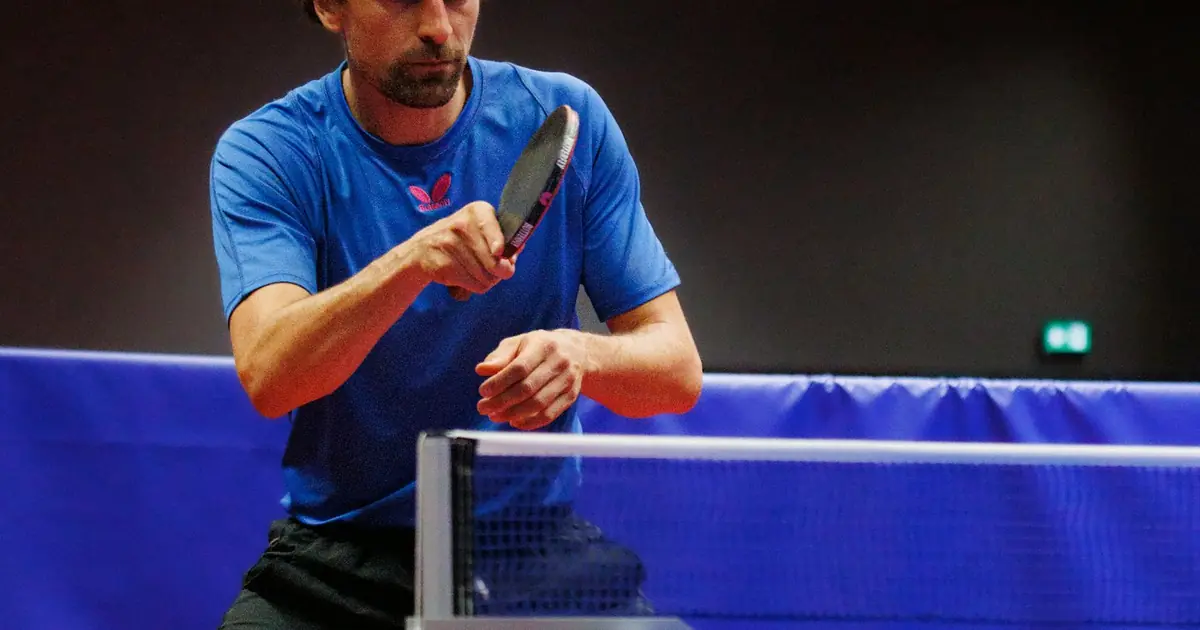
- Backhand block: Stand fairly square to the table, with the elbow in front of the body.
- Forehand block: Turn slightly so the racket-side leg is a little back, with the elbow bent out to the side.
- Bat height: Hold the bat at or just above table height in front of you, ready to move to either side.
Coaches often say a good block starts with the legs. A stable, crouched base lets you keep the arm movement small and still adjust to the ball. If you are reaching with your arm instead of moving your feet, see our table tennis footwork guide.
How to Block: Step by Step
These steps assume a right-handed player blocking a topspin ball on the backhand, the side where most blocks are played. The forehand block follows the same sequence with a slight turn of the waist.
- Read the incoming spin. Watch your opponent's swing. A long, upward brush means heavy topspin; a flatter, forward swing means more speed and less spin.
- Move into line. Take a small step so the ball arrives in front of your body, not beside it.
- Set the angle early. Close the bat face so it tilts forward over the ball. The heavier the topspin, the more closed it should be.
- Meet the ball on the rise. Contact it shortly after it bounces, before the top of the bounce. This keeps the spin from kicking the ball upward off your bat and gives your opponent less time.
- Use a short, forward stroke. Move the bat slightly forward and level from the elbow, with only a little upward travel. Keep the wrist mostly firm.
- Finish short. The follow-through should be about the same length as the backswing: small. Then return straight to the ready position.
- Place it. Aim for a wide angle, the opponent's elbow, or the opposite corner from where they just played.
Passive vs Active Blocks

Not every block is the same speed. The two basic types sit at opposite ends of a scale, and good blockers move along it during a match.
| Feature | Passive (Soft) Block | Active (Punch) Block |
|---|---|---|
| Power source | Almost entirely the opponent's pace | Your own forward push plus their pace |
| Grip | Relaxed, absorbing | Firmer |
| Bat movement | Very little, sometimes slightly backward to cushion | Short forward push with forearm and wrist |
| Ball returns | Slower, often shorter | Faster, deeper |
| Best use | Very hard balls, changing pace, drawing the attacker in | Pressuring the opponent, taking time away |
| Main risk | Gives an easy ball if it lands high or in the middle | Errors if you add too much speed |
A passive block is a perfectly valid tactical choice, especially against a powerful loop you cannot control any other way. Its weakness is that it puts no pressure on the opponent, and it relies on judging their pace and spin exactly. An active block adds a little of your own speed and some topspin, which many coaches consider more consistent once practiced. Push it too far and you are punch blocking, which is fast but risky.
The soft block is also a weapon in its own right. Against an opponent who has stepped back from the table expecting another hard ball, a gentle "pat" block that drops short can pull them forward and set up your next attack. The idea is to change the rhythm: pound, pat, then pound again.
Chop Block and Sidespin Block
These variations add spin of your own to the block. Both are usually easier on the backhand side and are best used occasionally, as a surprise, rather than as your standard return.
Chop Block
A chop block turns your opponent's topspin into backspin. The setup looks like a normal block, but the bat starts a little higher and more upright. At contact you move the bat down and across the back of the ball, usually adding some sidespin as well, with a loose grip so you can feel the ball.
- Start higher. Hold the bat above the expected contact point, face slightly closed.
- Brush down and across. Cut down and to the side through contact instead of pushing forward.
- Keep it short. The ball should drop short and low on the other side.
- Get ready to attack. The return is often weak or high, so prepare for your next shot.
The chop block works because it breaks the attacker's timing. They are expecting a fast topspin ball and instead get a short, dying ball with backspin, which often goes into the net if they swing as before. It is most effective against slower, spinny loops. Former world champions such as Jan-Ove Waldner and Ma Long are among the players known to use it.
Sidespin Block
A sidespin block adds sideways movement by moving the bat across the ball at contact, from right to left or left to right, while keeping the bat closed. The ball curves and kicks sideways after the bounce, often away from the opponent. Like the chop block, it is usually played soft, as a change of pace, and is easiest to learn on the backhand.
How Your Block Changes Against Different Spin
The bat angle is everything when blocking, and the right angle depends on what is coming at you. For background on why spin behaves this way, see our table tennis spin guide.
| Incoming Ball | Bat Angle | Adjustment |
|---|---|---|
| Heavy, slow topspin loop | Very closed | Take it early and stay over the ball; it tends to jump up and long |
| Fast, flatter drive | Slightly closed to near vertical | Absorb with a soft grip; the speed, not the spin, is the problem |
| Topspin with sidespin | Closed and turned slightly | Angle the bat toward the side the ball will kick, so it does not fly off the side |
| Flat ball with little spin | Nearly vertical | Push forward a little more; closing the bat sends it into the net |
| Ball from long pips | Varies, often more open | Spin is often reversed or low, so watch the opponent's stroke closely |
The biggest adjustment players need to make is against heavy loops. As a rule, close the bat more than feels natural. Understanding how the table tennis loop is produced also makes it easier to read how much spin is on the ball.
Common Blocking Mistakes and Fixes

| Mistake | What Happens | Fix |
|---|---|---|
| Bat too open for the spin | Ball pops up high or flies long | Close the face more, especially against loops |
| Contacting the ball too late | Spin kicks the ball up; opponent gets more time | Step in and meet the ball on the rise |
| Poking with a straight arm | No control, inconsistent contact | Keep the elbow bent and the stroke short |
| Floppy wrist | Angle changes at contact | Keep the wrist mostly firm and still |
| Reaching instead of moving | Off-balance blocks, weak placement | Use small adjusting steps to get behind the ball |
| Blocking back to the same spot | Opponent keeps attacking comfortably | Vary placement: wide corners and the playing elbow |
| Standing too far back | Block loses speed and timing | Stay close; move back only to loop or lob |
| Only ever blocking | Opponent controls the whole rally | Counter-attack the first weaker ball |
Blocking Drills to Practice
All of these work with a partner, and most can be done with a robot (see our best table tennis robots guide). Fit them into a regular routine like the ones in our ping pong practice guide.
- Block the loop, diagonal. Your partner loops crosscourt from the backhand corner; you block back to the same corner. Focus on angle and early timing before speed.
- Push, loop, block. Push long to your partner, who opens with a slow, spinny loop that you block. This is the classic way to learn to close the bat against heavy topspin.
- Placement ladder. Your partner attacks the same spot; you block to the backhand corner, then the middle, then the forehand corner, and repeat.
- Change of pace. Alternate a firm active block with a soft passive block that lands short. Your partner should feel the rhythm changing.
- Block, then attack. Block two balls, then counter-hit or loop the third. This trains the switch from defense to attack.
Expect blocks to fly long at first, especially against loops. Repetition builds the feel for angle faster than anything else. Once the backhand block is steady, work on the forehand side, which most players find harder because the forehand is usually used to attack. Our table tennis backhand and table tennis forehand guides cover the related strokes, and how to get better at ping pong puts it all into a training plan.
Frequently Asked Questions
What Is a Block in Table Tennis?
A block is a short, compact return of an attacking ball, usually topspin, played close to the table right after the bounce. Instead of making a big swing, you set the bat at the right angle and let the incoming speed and spin send the ball back.
Is Blocking a Defensive or Offensive Shot?
It is usually counted as a defensive stroke, but it does not have to be passive. An active block adds your own pace, and a well-placed block can win the point outright because an attacker who has just swung hard often cannot recover in time.
Why Do My Blocks Go Off the End of the Table?
The bat is almost always too open for the amount of topspin coming in. Close the bat face more, take the ball earlier off the bounce and shorten your stroke. Against heavy loops, players usually need a more closed angle than feels natural.
Can You Block a Backspin Ball?
Not in the normal sense. A block works with the topspin and pace your opponent provides. A backspin ball has to be lifted, so you push it, flick it or loop it instead. Blocking a backspin ball with a closed bat sends it into the net.
What Is a Chop Block in Ping Pong?
A chop block is a soft block where the bat moves down and across the ball at contact, turning the opponent's topspin into backspin, often with sidespin. The ball comes back short and low, which disrupts an attacker's timing. It is a variation to use occasionally, not a standard rally shot.
Should I Block or Counter-Attack?
Block when the ball is fast, heavily spun or you are rushed. Counter-attack when you have time, good position and the ball is not too strong. Many players block the first attack, then switch to counter-hitting or looping once the rally gives them a weaker ball.