Benefits of Table Tennis for Body, Brain and Social Life (2026)
 By Harshwardhan · Updated
In This Article
- What Are the Benefits of Table Tennis?
- Is Table Tennis Good Exercise?
- How Many Calories Does Table Tennis Burn?
- Physical Health Benefits
- Brain Health: What the Research Says
- Mental and Social Benefits
- Benefits for Older Adults
- Benefits for Kids
- A Sport for Almost Everyone
- How to Get the Most Health Benefit From Ping Pong
- The Bottom Line
- Frequently Asked Questions
What Are the Benefits of Table Tennis?
Most people think of ping pong as a basement game, but the health side is real. You are on your feet, moving in short bursts, tracking a light ball that changes speed and spin, and making a decision every second or so. That mix of light cardio and constant mental work is what sets it apart from a treadmill session.
Below is what the evidence actually supports: how much exercise it is, how many calories it burns, what research says about the brain, and who benefits most. Where the science is thin, we say so.
Quick Facts
- Intensity: About 4 METs for general play (moderate)
- Comparable to: Brisk walking (same moderate-intensity range)
- Calories: Roughly 240–400 per hour, depending on body weight
- Impact on joints: Low; no jumping or hard landings
- Who can play: Kids, adults, seniors and para athletes
Is Table Tennis Good Exercise?
Yes. Exercise scientists rate activities in METs (metabolic equivalents), where 1 MET is the energy you use sitting still. The Compendium of Physical Activities, the standard reference used by researchers, lists general table tennis at 4 METs. Anything from 3 to just under 6 METs counts as moderate intensity, and 4 METs is in the same range as walking at a brisk pace.
That matters because US guidelines from the CDC recommend at least 150 minutes a week of moderate-intensity activity for adults. Three 50-minute sessions of steady rallying would reach that target, and the time tends to pass much faster than on a stationary bike.
Keep in mind that the 4-MET figure describes general play. A relaxed garage rally with long breaks to chase the ball sits below it, while a club match with fast footwork and long points sits well above it. Top professionals train like any other elite athletes; watch Ma Long or Wang Chuqin cover the floor and it is obvious this is a full-body sport.
How Many Calories Does Table Tennis Burn?
A standard way to estimate calories is MET × body weight in kilograms × hours, because 1 MET is roughly 1 kcal per kilogram per hour. Applying that to the 4-MET rating for general play gives these estimates:
| Body Weight | Estimated Calories per 30 Minutes | Estimated Calories per Hour |
|---|---|---|
| 60 kg (132 lb) | 120 | 240 |
| 70 kg (154 lb) | 140 | 280 |
| 80 kg (176 lb) | 160 | 320 |
| 90 kg (198 lb) | 180 | 360 |
| 100 kg (220 lb) | 200 | 400 |
Estimates at 4 METs (general play). They include the calories you would burn at rest anyway, and real numbers vary with intensity, breaks and fitness.
Physical Health Benefits
Cardiovascular Fitness
Moderate-intensity activity done regularly is good for the heart, and table tennis gets you there in an enjoyable way. Because points are short with brief pauses between them, it works like gentle interval training: short bursts of effort followed by quick recovery.
Reflexes and Hand-Eye Coordination
The table is only 9 feet long, so the ball reaches you in a fraction of a second. Every shot asks you to read the spin, judge the bounce and move the paddle to the right spot. Practice sharpens this quickly, which is why coaches drill it so heavily; our guide to how to play table tennis covers the basic strokes that build it.
Balance, Footwork and Leg Strength
Good players are constantly shuffling side to side, bending their knees and shifting weight from one foot to the other. That repeated low stance builds leg strength and balance, which become more valuable with age.
Low Impact on the Joints
There is no running on pavement, no jumping and no collisions. That makes table tennis a comfortable option for people who find running or basketball hard on their knees and ankles. It is not completely free of strain, since the shoulder and wrist repeat the same motions, so warm up and build up your playing time gradually.
Brain Health: What the Research Says
Table tennis is often called a "brain sport," and the idea is reasonable: you are tracking a fast object, predicting where it will land, choosing a shot and executing it with fine motor control, over and over. The research is encouraging but still young.
- Children and teens: A 2024 narrative review in the journal Children pulled together studies of table tennis in young people, including children with ADHD and developmental coordination disorder, and linked the sport to improvements in executive functions and motor skills. A narrative review summarizes existing studies rather than running a new trial, and many of the studies it covers are small.
- People with Parkinson's disease: A small pilot study from Japan, publicized by the American Academy of Neurology in 2020, reported improvements in some everyday symptoms after six months of weekly ping pong. It had only about a dozen participants and no control group, so it is a starting point for research, not proof.
Mental and Social Benefits

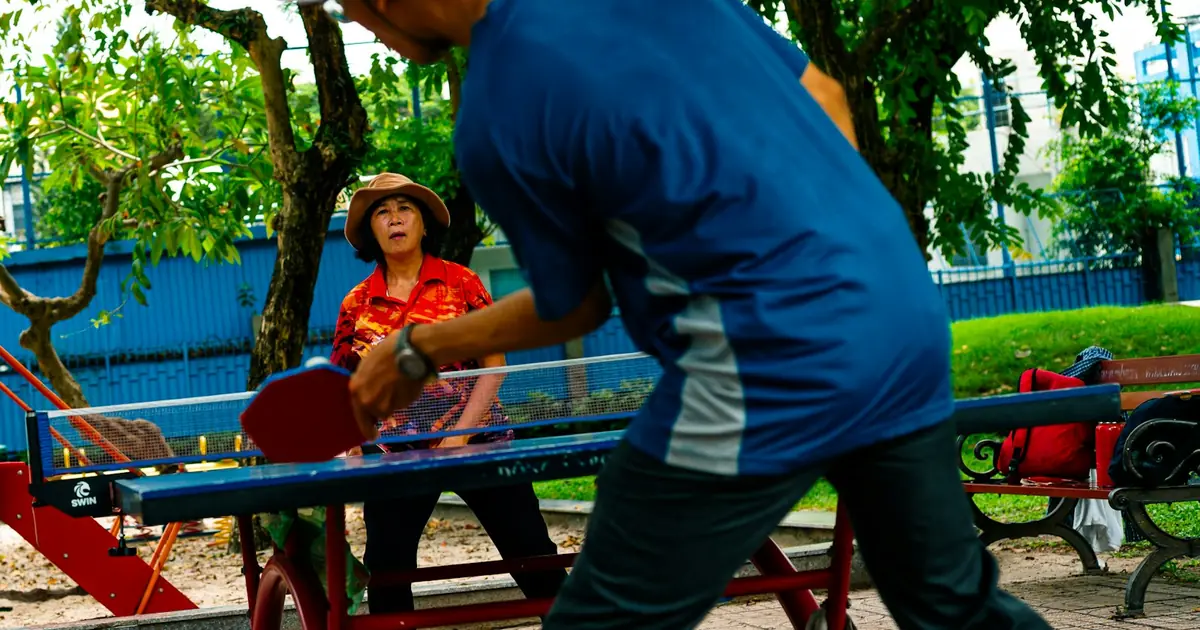
You cannot play table tennis alone at a table for long (unless you have a robot or a return board), so it naturally brings people together. It works across ages and skill levels, a parent can rally with a child, and doubles adds teamwork. That is a big reason companies install tables for breaks, as covered in our look at office ping pong.
The game also demands full attention. Because the next ball arrives in under a second, there is little room to think about anything else, which many players find a welcome mental break from work or screens.
Benefits for Older Adults
Table tennis is a common activity in senior centers and community clubs, and the appeal is clear: it is low impact, social and easy to scale from gentle rallies to competitive play.
One study published in 2018 compared 20 men in their late 60s who played recreational table tennis regularly with 20 sedentary men of similar age and weight. The players had higher bone mineral density, lower body fat, greater muscle strength in the arms and legs, better scores on a standard physical performance test and a faster 400-meter walk time. The study was small and cross-sectional, so it shows an association rather than proof that table tennis caused the differences, but the results line up with what you would expect from regular moderate exercise.
Benefits for Kids
For children, table tennis is affordable, safe and quick to learn. It builds coordination and concentration, rewards practice with visible progress, and does not depend on height or strength the way many sports do. The 2024 review mentioned above is the most complete summary of the research so far, and it points toward benefits for motor skills and executive functions. Simple rules make it easy to start; see our guide to the ping pong rules.
A Sport for Almost Everyone

Few sports are as inclusive. Table tennis has been part of the Paralympic Games since the very first one in 1960, with classes for wheelchair players, standing players and athletes with intellectual impairments; learn more in our guide to para table tennis. At the other end of the scale it is a full Olympic sport, as explained in table tennis at the Olympics.
How to Get the Most Health Benefit From Ping Pong
- Play regularly. Two or three sessions a week does more than one long weekend game.
- Minimize breaks. Keep spare balls handy so the rally rhythm stays continuous.
- Move your feet. Stepping to the ball instead of reaching works the legs and improves your game.
- Use proper technique. A sound grip and stroke spread the load across the body; start with our guide to table tennis grips.
- Warm up and cool down. A few minutes of light movement and stretching helps protect the shoulder, wrist and knees.
The Bottom Line
The benefits of table tennis are real and well matched to everyday life: moderate cardio comparable to brisk walking, sharper reflexes and coordination, low stress on the joints, and a social game that people actually stick with. The brain-health research is promising but early, so enjoy it as a fun, healthy habit rather than a cure. If you want to get better as you go, our ping pong practice guide is a good next step.
Frequently Asked Questions
Is Table Tennis Good Exercise?
Yes. Recreational table tennis is rated at about 4 METs, which puts it in the moderate-intensity range alongside brisk walking. Long, fast rallies and competitive matches push the effort higher.
How Many Calories Do You Burn Playing Table Tennis for an Hour?
A rough estimate is 240 calories per hour for a 60 kg (132 lb) person and about 320 for an 80 kg (176 lb) person, based on a 4-MET rating. Actual burn depends on how hard and how continuously you play.
Is Ping Pong Good for Your Brain?
It keeps your brain busy with fast visual tracking, decisions and fine motor control, and a 2024 review of research in children linked it to gains in executive functions and motor skills. Evidence in adults is still limited, so treat it as a promising brain-friendly activity rather than a proven treatment.
Is Table Tennis Good for Seniors?
It is a popular choice for older adults because it is low impact, social and easy to scale to any fitness level. A small study of men in their late 60s found regular players had better strength, physical performance and bone density than sedentary peers.
Is Table Tennis Hard on the Joints?
Compared with running or court sports with hard landings, table tennis puts little impact through the joints. It still involves quick lateral steps and repeated arm swings, so warming up and building up playing time gradually is sensible.
Can You Lose Weight Playing Ping Pong?
Ping pong burns calories and counts toward weekly activity goals, so it can support weight loss alongside sensible eating. On its own, an hour of casual play burns a modest amount, so frequency and intensity matter.
Sources and References
- Ainsworth et al.: Compendium of Physical Activities, an Update of Activity Codes and MET Intensities (PubMed)
- Wikipedia: Metabolic Equivalent of Task
- CDC: Adult Activity, an Overview
- Naderi et al. (2018): A Retrospective Comparison of Physical Health in Regular Recreational Table Tennis Participants and Sedentary Elderly Men (PMC)
- Benefits of Table Tennis for Children and Adolescents: A Narrative Review, Children (2024) (PMC)