Office Ping Pong: The Table, the Lore and the House Rules (2026)
 By Harshwardhan · Updated
In This Article
Office Ping Pong in a Nutshell
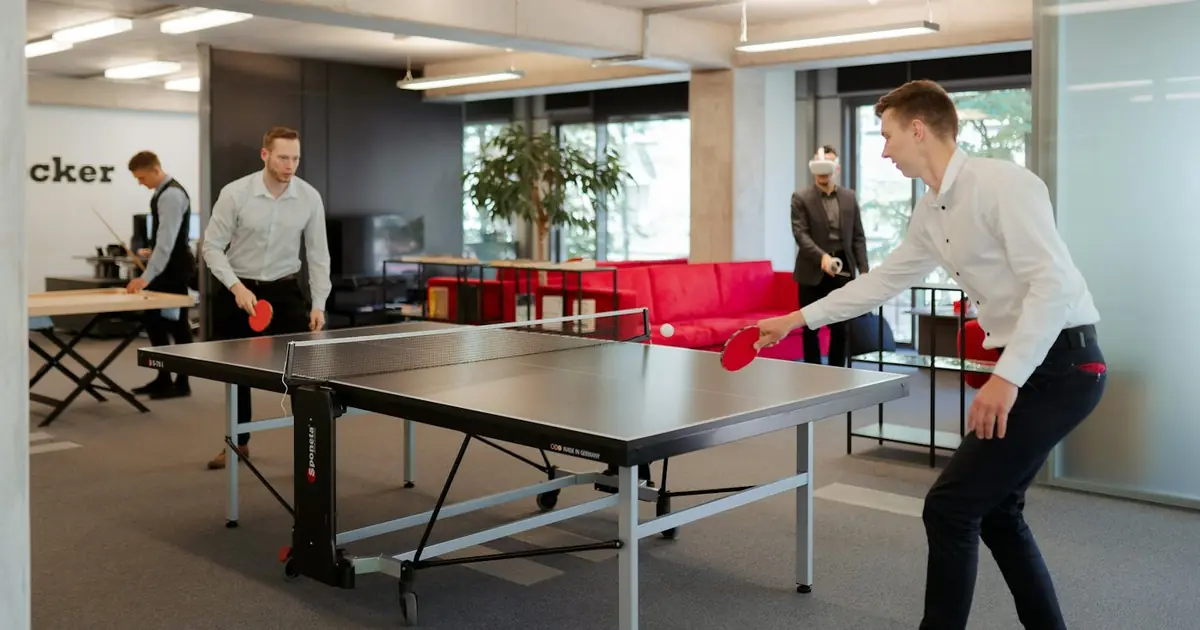
Few office perks are as recognizable as the ping pong table. It shows up in startup lofts, agency break rooms and sitcoms, and for a while it was even treated as an economic indicator. It is also easy to get wrong: put a table next to the sales floor with no rules and it becomes the loudest thing in the building.
This guide covers why offices buy tables, the famous tech-bubble story, the ping pong episode of The Office, practical house rules, how to set up a table at work and how to run a tournament people actually finish.
Quick Facts
- Regulation table: 9 x 5 ft, 30 in high (2.74 x 1.525 x 0.76 m)
- Suggested room for casual play: about 19 x 11 ft (STIGA home guideline)
- Game length: first to 11, win by 2; serve alternates every 2 points
- Famous TV moment: The Office, "The Deposition" (Season 4, Episode 12, 2007)
- Famous news story: 2016 Wall Street Journal report linking falling corporate table sales to a startup funding slowdown
Why So Many Offices Have Ping Pong Tables
Ping pong fits office life better than most games. It is quick to learn, a game to 11 takes only a few minutes, two or four people can play, and a decent table costs far less than renovating a lounge. It also lets people of very different skill levels have fun together, which is not true of every sport.
Common reasons companies give for adding a table:
- A real break from screens. A short game gets people standing and moving, which is a welcome change from sitting at a desk. See the benefits of table tennis for the bigger picture.
- Cross-team mixing. A waiting list by the table puts people from different departments in the same place.
- Recruiting signal. In the 2010s, a table became shorthand for a relaxed, startup-style workplace.
- Flexible space. A conversion top can turn a conference table into a game table after hours.
The perk has critics too. A table is not a substitute for reasonable workloads, and some employees will never touch it. Treat it as one small amenity, not a culture strategy.
The Ping Pong Table as a Tech-Bubble Indicator

The most famous office ping pong story is not about a match at all. In spring 2016, the Wall Street Journal ran a piece headlined "Is the Tech Bubble Popping? Ping-Pong Offers an Answer." It featured Billiard Wholesale, a San Jose company that sells tables to Silicon Valley businesses, including Twitter.
The owner, Simon Ng, said his table sales to companies fell about 50 percent in the first quarter of 2016 compared with the previous quarter. The paper set that beside a drop of roughly 25 percent in US startup funding over the same period, per Dow Jones VentureSource. The story spread quickly through outlets such as GeekWire, Fox News and the public radio show Marketplace.
The same coverage quoted Lithium Technologies CTO Sunil Rajasekar: "If you don't have a ping-pong table, you're not a tech company." That line, half joke and half truth, explains why the table became a cultural symbol in the first place. Treat the "ping pong index" as a fun anecdote from one seller, not a real economic data series.
Ping Pong in The Office (US)
If someone in your break room says "That's a Dwight serve," they are probably thinking of The Office. The show's ping pong episode is "The Deposition," Season 4, Episode 12, which first aired on NBC on November 15, 2007. It was written by Lester Lewis and directed by Julian Farino.
What Happens in "The Deposition"
- Darryl keeps beating Jim at ping pong, and Kelly gloats about it to Pam.
- Pam builds a makeshift table in the conference room so Jim can practice against coworkers.
- Jim discovers that Dwight is very good at the game.
- In the rematch, Darryl beats Jim again.
- Dwight plays an intense game against his cousin Mose that ends in an apparent stalemate.
Behind the Scenes
According to Wikipedia's episode article, the ball in the Dwight vs. Mose game was added digitally in post-production while Rainn Wilson and Michael Schur mimed the rally. The other matches used no visual effects; they were tightly scripted and took many takes. Matches between Phyllis and Stanley, Jim and Creed, and Jim and Andy were cut before broadcast.
Pam's conference-room table is also the most relatable part of the episode: plenty of real offices start exactly that way. For more screen moments, see our roundup of ping pong movies.
Office Ping Pong Etiquette and House Rules

Most office ping pong problems are about people, not table quality. A short, posted set of rules prevents nearly all of them. Start with the official ping pong rules for scoring, then add workplace rules on top.
Suggested House Rules
- Play to 11. Win by 2, two serves each. Short games keep the line moving; save best-of-5 matches for tournaments.
- Winner stays, loser rotates. When someone is waiting, the winner stays on for a set number of games (two is common), then everyone rotates. Use a whiteboard or chat channel for a queue at busy times.
- Respect quiet hours. Agree on times with no play, for example during all-hands meetings or when nearby rooms host client calls.
- Keep serves simple. Casual office games go better when serves are tossed and clearly visible. Our guide to legal serves explains the official version.
- Return the gear. Paddles back on the rack, balls back in the box, nothing left on the table surface.
- Keep drinks off the table. Spills warp tops and leave sticky spots.
- Trash talk stays friendly. Keep it light and drop it entirely with newcomers.
Setting Up a Ping Pong Table at Work
Space
A regulation table measures 9 x 5 ft and stands 30 in high. STIGA's guideline for home play is a room of about 19 x 11 ft, which leaves roughly 5 ft behind each end and 3 ft at each side. Formal competition needs far more: ITTF international events require at least 14 x 7 m. For full measurements, see our ping pong table dimensions guide.
In a smaller room, players will still have fun, but expect shorter rallies and more balls bouncing off walls. Also check for low lights, ducts and glass partitions above and around the play area.
Noise
The tock of the ball and the occasional shout carry further than people expect, especially in open-plan offices with hard floors. Practical ways to reduce complaints:
- Put the table in a room with a door, or at least away from desks, phone booths and meeting rooms.
- Keep soft surfaces nearby, such as acoustic panels, rugs around the play area (not under players' feet) or upholstered seating.
- Use quiet hours (see the house rules above).
Conversion Tops: The Conference Room Option
If you have a large meeting table, a conversion top turns it into a full-size playing surface without adding a second piece of furniture. Tops come in halves, so they can be stored when the room is needed for meetings. Regulation height is 30 in, and the table underneath will not always match it, so play may feel a touch high or low. A top with a metal apron or rail helps keep the surface flat where it overhangs a smaller base. Our best table tennis conversion tops guide compares more options.
JOOLA Conversion Top with Metal Apron
Best for: Offices that want to turn a large meeting table into a full-size ping pong table
A 15 mm regulation-size top in two halves with a 1.5 in tubular steel apron and 10 EVA foam pads. The apron makes it a sensible match for a conference or dining table that is smaller than the top itself.
| Thickness | 15 mm engineered wood |
|---|---|
| Size | 9 x 5 ft (regulation) |
| Sections | 2 halves |
| Net | Clamp-style net and post set |
| Underside | 10 EVA foam pads |
| Support | 1.5 in tubular steel apron |
| Weight | 117 lb |
Pros
- Steel apron helps the top stay flat where it overhangs a smaller base table
- Regulation 9 x 5 ft playing surface
- Clamp net attaches like a standard table net
Cons
- Foam pads protect contact points, not the whole underside
- Heavy: plan on two people to lift it on and off
- Playing height depends on the table underneath
Budget Tiers
Prices change often, so think in tiers rather than numbers. Our ping pong table prices guide covers what each level typically includes.
| Tier | Typical Setup | Good For | Watch For |
|---|---|---|---|
| Budget | Midsize table or conversion top on an existing table | Small offices, testing interest | Odd height, shorter rallies, top storage |
| Mid-range | Full-size indoor folding table | Most break rooms | Floor space when unfolded, assembly time |
| Premium | Thicker-top tournament-style or design-led table | Dedicated game rooms, frequent players | Weight, delivery and installation logistics |
A folding table is usually the safest choice because it can be rolled aside for events or used solo with one half raised. See the best folding ping pong tables for full-size picks.
JOOLA Midsize
Best for: Break rooms and small offices with no space for a 9 x 5 ft table
A 6 x 3 ft table at full playing height that ships assembled and folds to roughly 36 x 36 in. It suits offices that want casual games without giving up a whole room.
| Size | 72 x 36 x 30 in |
|---|---|
| Storage | Folds to about 36 x 36 in |
| Net | Custom-size screw-clamp net and posts |
| Assembly | Ships fully assembled |
| Weight | 62 lb |
| Use | Indoor |
Pros
- Regulation 30 in height on a 6 x 3 ft footprint
- Arrives assembled and folds small for storage
- Light enough for one adult to move
Cons
- Not regulation length or width
- Too small for full-speed adult rallies
Office Ping Pong Tournament Ideas
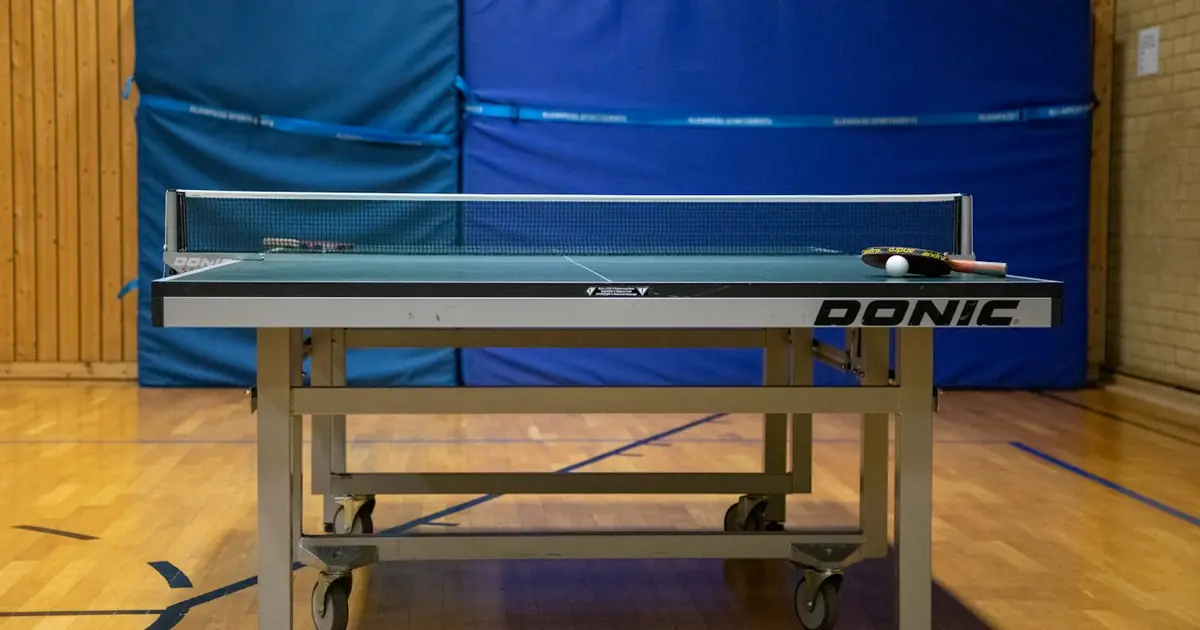
A tournament gives a quiet table a second life and is one of the easiest team events to run. Keep it simple: sign-ups, a format, a bracket on the wall and a small trophy.
| Format | How It Works | Best For |
|---|---|---|
| Single elimination | Lose once and you are out | Big groups, one-day events |
| Round robin groups | Everyone in a group plays everyone; top finishers advance | Making sure everyone gets several games |
| Ladder | Challenge anyone a few rungs above you; win and swap places | Ongoing play over weeks or months |
| Doubles | Pairs, ideally mixing strong and new players | Mixed-ability teams |
| Handicap games | Stronger players start a few points down | Leveling the field |
Tips for a Smooth Tournament
- Use short matches. Best of 3 games to 11 keeps a lunchtime bracket on schedule.
- Set deadlines. Give each round a date, and let the bracket organizer decide no-shows.
- Explain doubles serving. Many casual players have never played official doubles; share the table tennis doubles rules before it starts.
- Add side games. Around the World and other group formats keep spectators involved; see our list of ping pong games to play.
- Celebrate everyone. Small prizes for "most improved" or "best rally" matter more than the trophy.
Bottom Line
Office ping pong works when the table fits the space, sits away from people who need quiet, and comes with a few clear house rules. A conversion top or midsize table is an easy way to test interest, and a short tournament turns a forgotten table into a team event. The tech-bubble story and Dwight's mimed rally are fun lore, but the real value is simpler: a few minutes away from the screen with a coworker across the net.
Frequently Asked Questions
Is It a Good Idea to Have a Ping Pong Table at Work?
It can be, if the table sits away from desks and meeting rooms and there are simple house rules about noise, time limits and sharing. A table placed next to people on calls tends to cause more friction than fun.
How Much Space Does an Office Ping Pong Table Need?
A regulation table is 9 x 5 ft, and STIGA's guideline for home play is a room of about 19 x 11 ft. A 6 x 3 ft midsize table or a conversion top on an existing conference table works in tighter spaces.
Which Episode of The Office Has Ping Pong?
Season 4, Episode 12, "The Deposition," which aired on NBC on November 15, 2007. Darryl keeps beating Jim, Pam sets up a makeshift table in the conference room, and Jim discovers Dwight is very good.
Did Ping Pong Table Sales Really Predict a Tech Bubble?
Not really. In 2016 the Wall Street Journal reported that a San Jose table seller's corporate sales fell sharply as startup funding dropped, but the seller himself said the trend tracks the tech market rather than predicting it.
What Are Good Rules for an Office Ping Pong Table?
Play games to 11, rotate the winner off or use a sign-up list when people are waiting, keep quiet hours around important meetings, and return paddles and balls after each game. Post the rules next to the table.
How Do You Run an Office Ping Pong Tournament?
Collect sign-ups, pick a format such as single elimination or round robin groups, play short best-of-3 matches, and post a bracket people can update. Doubles and handicaps help mixed-ability groups enjoy it.