Ping Pong Rules and Scoring: What the Official Laws Really Say (2026)
In This Article
- Ping Pong Rules in One Minute
- The Equipment Basics
- The Service
- The Return and Order of Play
- When a Rally Is a Let
- How a Point Is Won or Lost
- Game and Match Scoring
- Doubles Rules in Brief
- Common Rules Questions, Answered
- House Rules vs the Official Table
- Why 21 Points Became 11, and Other Rule Changes
- The Rules That Matter Most
- Frequently Asked Questions
Ping Pong Rules in One Minute
The basic ping pong rules are simple: serve the ball so it bounces once on your side and once on your opponent's side, then take turns hitting it back over the net so it lands on the other side. You win a point when your opponent fails to make a good return. The first player to 11 points wins the game, you must win by 2, and a match is usually best of 5 or best of 7 games.
Those are the official table tennis rules too. "Ping pong" and "table tennis" are the same sport (see ping pong vs table tennis for the story behind the two names), and the worldwide rulebook is the ITTF's Laws of Table Tennis, Laws 2.1 to 2.15. This guide walks through them in plain English, with the scoring system, every way a point is won or lost, and the backyard myths worth dropping.
Quick Facts
- Points per game: 11, win by 2 (Law 2.11)
- Match length: best of an odd number of games, usually 5 or 7 (Law 2.12)
- Serves: 2 each, then switch; 1 each from 10-10 (Law 2.13)
- Change ends: after every game, and at 5 points in the deciding game
- Old system: 21-point games with 5 serves each, replaced in September 2001
The Equipment Basics
You do not need to memorize every specification to play by the rules, but these are the official numbers from Laws 2.1 to 2.4.
| Item | Official Rule |
|---|---|
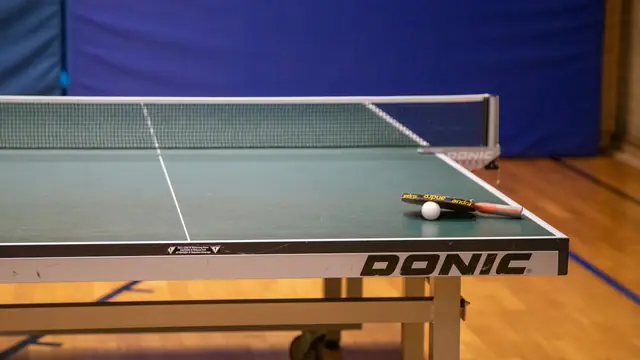
| Table | 2.74 m long, 1.525 m wide (about 9 ft by 5 ft), playing surface 76 cm (about 30 in) above the floor, dark matt surface with 2 cm white lines |
| Net | Top edge 15.25 cm (6 in) above the playing surface along its whole length; posts 15.25 cm outside the side lines |
| Ball | 40 mm diameter, 2.7 g, plastic, matt, white or orange |
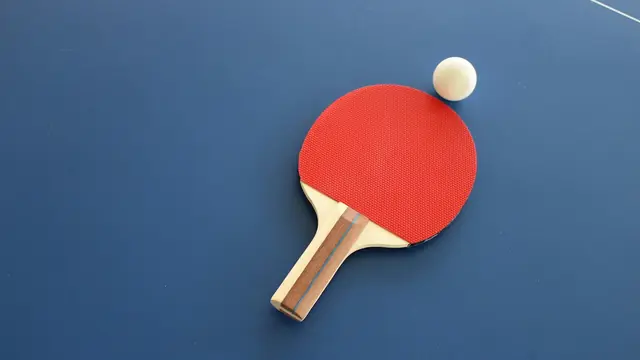
| Racket | Any size, shape or weight; blade at least 85% natural wood by thickness; one side black, the other a bright colour clearly different from black and from the ball |
For full measurements, including clearance around the table, see our ping pong table dimensions guide. Ball specifications get their own page at ping pong ball size, and the bigger picture is in our table tennis equipment overview.
One detail matters during play: the vertical sides of the tabletop are not part of the playing surface. That is the basis of the famous edge-versus-side rule covered below.
The Service
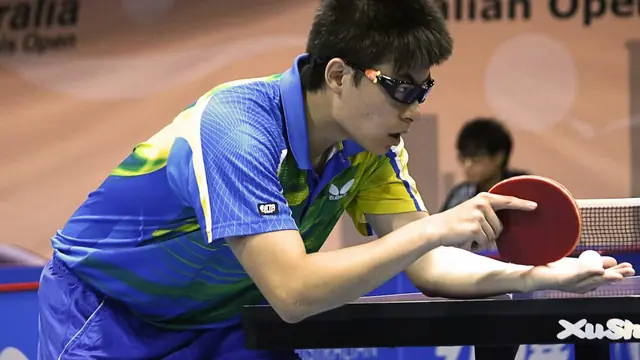
Every rally starts with a serve, and it is the rule most often broken in casual games. Under Law 2.6, a legal serve means:
- Open palm. The ball rests on the flat, stationary palm of your free hand.
- Toss it up. Project the ball near vertically, without spin, so it rises at least 16 cm after leaving your hand.
- Hit it falling. Strike the ball as it drops, without it touching anything first.
- Stay behind the line. The ball must be above the level of the playing surface and behind your end line from the start of the serve until it is struck.
- Bounce, then bounce. The ball must touch your court first, then pass over or around the net and touch the receiver's court.
- Do not hide it. The ball cannot be hidden from the receiver by your body or clothing, and your free arm must move out of the space between the ball and the net once you toss.
In singles you can serve anywhere on the receiver's side; the diagonal requirement only applies in doubles. For the details, including what umpires watch for, read our table tennis serve rules guide, and for technique see how to serve in ping pong.
The Return and Order of Play
After the serve, the receiver must hit the ball so it passes over or around the net and touches the server's court, either directly or after touching the net assembly (Law 2.7). The ball may bounce only once on your side before you hit it. You cannot volley it, and you cannot let it bounce twice.
In singles, players simply alternate: server, receiver, server, receiver. In doubles, the order is fixed: server, receiver, server's partner, receiver's partner, and repeat (Law 2.8). Hitting out of turn in doubles loses the point.
When a Rally Is a Let
A let is a rally that ends with no point scored and is simply replayed. Under Law 2.9, the main lets are:
- A serve that is otherwise correct touches the net assembly (net or posts) and then lands on the receiver's court, or is obstructed by the receiver or partner.
- The serve is delivered when the receiver is not ready, as long as neither the receiver nor partner tries to hit it.
- Something outside the players' control disturbs the rally, such as a ball rolling onto the court from the next table.
- The umpire interrupts play, for example to correct the order of serving or ends, to introduce the expedite system, or to warn or penalize a player.
There is no limit on how many net-touching lets a server can produce in a row; each one is replayed.
How a Point Is Won or Lost
Law 2.10 is the heart of ping pong scoring. You win a point if your opponent does any of the following.
| Your Opponent... | Result |
|---|---|
| Fails to make a correct serve | Your point |
| Fails to make a correct return (into the net, off the table, or misses) | Your point |
| Lets your good shot touch anything other than the net assembly before hitting it, such as the floor, a wall or their body | Your point |
| Hits a ball that sails over or beyond your court without touching it | Your point |
| Hits a ball that passes through the net, or between the net and the post or table | Your point |
| Obstructs the ball (touches it above or heading towards their side of the table before it bounces) | Your point |
| Deliberately strikes the ball twice in succession | Your point |
| Hits with a side of the racket blade whose surface does not meet the covering rules | Your point |
| Moves the playing surface (with body, racket or clothing) | Your point |
| Touches the net assembly (with body, racket or clothing) | Your point |
| Touches the playing surface with their free hand | Your point |
| Hits out of turn in doubles | Your point |
| Fails to win the point within 13 of your returns while the expedite system is on (they are serving) | Your point |
The law also includes extra conditions for wheelchair play, such as a player's thigh leaving the seat when hitting.
Two definitions make this list work. A player "strikes" the ball when touching it with the racket held in the hand, or with the racket hand below the wrist (Law 2.5.7). A player "obstructs" the ball when they, or anything they wear or carry, touch it while it is above or travelling towards their own playing surface before it has bounced there (Law 2.5.8).
Game and Match Scoring
Want a point-by-point walkthrough, deuce explained and how umpires call the score? See our full guide to table tennis scoring.
Table tennis scoring is rally scoring: a point goes to someone on every rally, no matter who served. Here is how the points build into games and matches.
| Scoring Question | Official Answer |
|---|---|
| Points to win a game | 11 |
| Win by | 2 points (from 10-10, play on until one side leads by 2) |
| Can a game go past 11? | Yes, with no cap: 12-10, 14-12, 20-18 and so on |
| Games in a match | Best of an odd number, usually best of 5 (first to 3) or best of 7 (first to 4) |
| Serves per turn | 2, then service passes to the opponent |
| Serves from 10-10 | 1 each, alternating |
| Who serves first | Decided by lot (often a coin toss); the winner chooses to serve, receive or pick an end |
| Next game | The player who served first in the previous game receives first |
| Changing ends | After each game, and in the last possible game when one side first reaches 5 points |
What Deuce Means
The official laws never use the word, but players call 10-10 "deuce," borrowing from tennis. From that point, serve alternates after every point instead of every two, and the game is won by the first side to go 2 points ahead. A player one point ahead at deuce is said to have "advantage."
Calling the Score
By convention the server's score is called first. So if you are serving and trailing 4 points to 7, the score is "4-7." In matches, the games score is tracked separately, such as "2 games to 1."
The Expedite System
To stop very long defensive games, Law 2.15 adds a time rule. If a game is unfinished after 10 minutes of play, the expedite system starts, unless at least 18 points have already been scored (for example 9-9). It can also start earlier if both players ask. From then on, players serve one point each in turn, and if the receiver makes 13 correct returns in a rally, the receiver wins the point. Once introduced, it stays in force for the rest of the match.
Doubles Rules in Brief
Doubles uses the same scoring, with three key differences. The serve must go diagonally, from the server's right half-court to the receiver's right half-court, with the centre line marking the halves. Partners must hit alternately in a fixed sequence. And the serving and receiving order rotates in a set pattern so every player serves to and receives from a specific opponent; in the deciding game, the receiving pair switches its order when one side reaches 5 points. Our upcoming table tennis doubles rules guide covers the rotation step by step.
Common Rules Questions, Answered
Can the Ball Hit the Net?
Yes. During a rally, a shot that clips the net or post and still lands on the opponent's court is good and play continues. On the serve, an otherwise good ball that touches the net and lands in is a let and is replayed.
Edge vs Side: Which Counts?
The top edge of the table counts as part of the playing surface, so an edge ball is good, however unlucky it feels for the receiver. The vertical sides of the tabletop are not part of the playing surface, so a ball that hits the side below the edge is out. A rough guide: if the ball keeps travelling up or onward after touching the corner, it most likely hit the edge; if it drops sharply downward, it most likely hit the side.
Can You Hit the Ball Before It Bounces?
Not over the table. Touching the ball while it is above or heading towards your side before it has bounced is obstruction and loses the point. But if the ball has already passed your end line or gone wide of the table without touching your court, it is not obstruction. Catching or hitting it then does not matter, because your opponent's shot was already out.
Can You Touch the Table?
Yes, with your racket hand or body, provided you do not move the table. Moving the playing surface, touching the net assembly, or putting your free hand on the playing surface loses the point. Leaning on the table with your free hand during a rally is one of the most common ways casual players give away points without noticing.
Can You Hit the Ball With Your Hand?
Only with your racket hand below the wrist, which counts as a legal strike. So if the ball glances off your fingers on the handle and goes in, play continues. Hitting with your free hand, your forearm or any other part of the body is not a strike, and the ball touching you before you hit it loses the point. How you hold the racket is up to you; our table tennis grips guide covers the common options.
What About an Accidental Double Hit?
The current law only penalizes a player who deliberately strikes the ball twice in succession. A genuinely accidental double touch during one stroke is not on the list of faults.
House Rules vs the Official Table
Basement and office games often run on rules handed down rather than read. Here is how the most common ones compare.
| House Rule | Official Rule |
|---|---|
| Games to 21 with 5 serves each | Games to 11 with 2 serves each (since 2001) |
| Singles serve must go diagonally | Diagonal serve is a doubles rule only |
| The serve can be hit straight onto the opponent's side | The serve must bounce on your own side first |
| Three net serves in a row and you lose the point | No limit; every net-touching good serve is a let |
| "Volley for serve" decides who serves | Decided by lot, usually a coin toss |
| A ball hitting your body over the table is fine | Obstruction: you lose the point |
House rules are fine if everyone agrees, but if you want to learn how to play table tennis properly or enter a club league, the official version is worth learning early.
Why 21 Points Became 11, and Other Rule Changes
Older players remember games to 21 with five serves each. The ITTF switched to 11-point games in September 2001, cutting the serve rotation from five points to two at the same time. The idea was to make games shorter and more decisive, with more pressure points per match, which also suits television and spectators.
That change was part of a run of reforms:
- October 2000: the 38 mm ball was officially replaced by the 40 mm ball, which is slightly larger and slower through the air.
- September 2001: 11-point games and two serves each replaced 21-point games and five serves each.
- 2002: service rules changed to stop players hiding the ball from the receiver during the serve.
- July 2014 onward: major events moved from celluloid balls to plastic (poly) balls.
The Rules That Matter Most
If you remember only a handful of ping pong rules, make it these: toss the serve up from an open palm and bounce it on your side first; let the ball bounce once, never twice and never zero times over the table; keep your free hand off the table; play to 11, win by 2; and switch serve every two points until 10-10. Those cover nearly every argument at the table. Then put them to work at the table.
Frequently Asked Questions
How Many Points Do You Need to Win a Game of Ping Pong?
Eleven. The first player or pair to 11 points wins the game, but if the score reaches 10-10 the game continues until one side leads by 2 points, for example 12-10 or 15-13.
How Many Sets Are in a Table Tennis Match?
Official rules call them games, and a match is the best of an odd number of them. Most matches are best of 5 (first to 3 games) or best of 7 (first to 4 games), with best of 7 common at the top level.
Can the Ball Hit the Net in Ping Pong?
Yes, during a rally. A return that touches the net or its posts and then lands on the opponent's court is good. On the serve, a ball that touches the net and still lands correctly is a let and is replayed.
Can You Hit the Ball Before It Bounces in Ping Pong?
No. If you touch the ball while it is above or travelling towards your side of the table before it has bounced there, that is obstruction and your opponent wins the point. If the ball has already passed your end line or gone wide, it is out and you win the point.
Can You Touch the Table in Ping Pong?
You can touch it with your racket hand or body as long as you do not move the table. Touching the playing surface with your free hand, moving the table or touching the net assembly loses the point.
Is It Legal to Hit the Ball With Your Hand?
Only with the hand holding the racket, below the wrist. The laws count that as a legal strike. Hitting the ball with your free hand, or with your racket hand above the wrist, loses the point.
Do You Have to Serve Diagonally in Ping Pong?
Only in doubles, where the serve goes from the server's right half-court to the receiver's right half-court. In singles the serve can bounce anywhere on the receiver's side.