Ping Pong Terms: The A–Z Glossary Every Player Should Know (2026)
In This Article
Ping Pong Terms in Plain English
Ping pong terms fall into a few families: rules and scoring words (let, deuce, expedite), stroke names (loop, chop, push, flick, smash), spin words (topspin, backspin, heavy, dead), equipment words (blade, rubber, sponge, pips) and grip and style names (shakehand, penhold, chopper, looper). Learn about 30 of them and you can follow almost any match commentary or coaching video.
This glossary groups the terminology by topic so you can scan the section you need, with a one- or two-line definition for each term. Rules terms follow the official ITTF Laws of Table Tennis; for the full rulebook in plain English, see our ping pong rules guide.
Quick Facts
- Official name: table tennis (used by the ITTF, founded in 1926, and at the Olympics)
- Everyday name: ping pong, from the sound of the ball
- Trademark: Ping-Pong was trademarked by J. Jaques & Son in 1901; the US mark is now owned by Escalade Sports
- Official word for the bat: racket (bat and paddle are informal)
- Most-asked term: let, a rally that is replayed with no point scored
Why Is It Called Ping Pong?
The name is an imitation of a sound. Once lightweight celluloid balls arrived around 1900 and 1901, the ball made a sharp, distinctive noise off the paddle and the table, and people began calling the game after it. Other sound-based nicknames of the era included "whiff-whaff," "pom-pom" and "clip-clap."
The name became a brand almost immediately. London sports maker J. Jaques & Son, which had sold early sets in the 1890s under the name "Gossima," trademarked "Ping-Pong" in 1901. "Ping-pong" then came to mean the game played with Jaques equipment, while other makers called it table tennis. Jaques sold the US rights to Parker Brothers, which enforced the trademark in the 1920s, pushing American associations to adopt the name "table tennis." The ITTF, formed in 1926, uses the same name, and the US "Ping-Pong" trademark is still active today, owned by Indian Industries, Inc., doing business as Escalade Sports.
| Year | Naming Milestone |
|---|---|
| 1890s | Jaques sells early sets as "Gossima" |
| c. 1900–1901 | Celluloid balls arrive; sound-based names spread |
| 1901 | J. Jaques & Son trademarks "Ping-Pong" |
| 1920s | Parker Brothers enforces the name in the US; associations switch to "table tennis" |
| 1926 | The International Table Tennis Federation is founded |
Is there any real difference between the two names today? Not in the rules. Our ping pong vs table tennis page explains how people use each one, and the wider story is in the history of table tennis.
Rules and Scoring Terms
These words come straight from the rulebook or from the way umpires and players talk about the score.
| Term | Meaning |
|---|---|
| Let | A rally that is not scored and is replayed. Most often a serve that touches the net and still lands correctly, but also called if the receiver was not ready or play is disturbed. |
| Net ball | A ball that clips the net during a rally and drops onto the opponent's side. Unlike a net serve, it is good and play continues. |
| Edge ball | A ball that hits the top edge of the table. The edge is part of the playing surface, so it counts; a ball that hits the vertical side does not. |
| Deuce | Nickname for 10-10. From there, serve alternates every point and a player must lead by 2 to win the game. |
| Advantage | Being one point ahead after deuce, for example 11-10. |
| Game | Played to 11 points, win by 2. Many players call it a set, but the laws say game. |
| Match | The best of an odd number of games, usually best of 5 or best of 7. |
| Rally | The period when the ball is in play, from the serve until a point is decided or a let is called. |
| Service / server / receiver | The serve starts each rally; the server hits first and the receiver hits second. Serve switches every 2 points, and every point from 10-10. |
| Obstruction | Touching the ball while it is over or heading towards your side of the table before it bounces there. It loses the point. |
| Double bounce | Letting the ball bounce twice on your side before returning it. You lose the point. |
| Free hand | The hand not holding the racket. Touching the playing surface with it loses the point. |
| Expedite system | A time rule. If a game is unfinished after 10 minutes (unless at least 18 points have been scored), players serve one point each in turn and the receiver wins the point after 13 good returns. |
| Umpire / assistant umpire / referee | The umpire runs the match at the table, the assistant umpire helps with some decisions, and the referee is in charge of the whole tournament. |
Scoring gets its own walkthrough in our table tennis scoring guide, and the toss, the 16 cm rule and hidden serves are covered in table tennis serve rules.
Strokes and Shots
Stroke names describe what the racket does to the ball. Most are either attacking (adding speed or topspin) or controlling (adding backspin or taking pace off).
| Term | Meaning |
|---|---|
| Forehand / backhand (FH / BH) | Forehand is played on the racket-hand side with the palm facing forward; backhand is played across the body on the other side. |
| Drive | A forward and slightly upward stroke close to the table with mild topspin. Usually the first attacking stroke beginners learn. |
| Loop | A heavy topspin stroke made by brushing up the back of the ball. The core attacking shot of the modern game. |
| Counter-loop | A loop played against an opponent's loop, so both players are hitting topspin. |
| Smash | A fast, flat, powerful shot, usually hit against a high or weak return to end the point. |
| Kill | Any shot hit so hard it is not expected to come back. |
| Push | A backspin stroke played over the table against a backspin ball, similar to a slice in tennis. Used to keep the ball low and the rally safe. |
| Chop | A defensive stroke with heavy backspin, usually played well back from the table with a downward swing. |
| Block | A short, compact return close to the table that uses the opponent's pace against them. |
| Chop block | A block with a quick downward motion that turns the opponent's topspin into backspin. |
| Flick (flip) | An attacking shot played over the table against a short ball, using a quick wrist action. "Flick" has largely replaced the older word "flip." |
| Banana flick | A backhand flick with topspin and sidespin that makes the ball curve, like a banana. Czech player Petr Korbel is often credited with popularizing it. |
| Strawberry flick | A flick with the opposite sidespin to the banana flick, used as a variation. |
| Drop shot | A very short, soft return that lands just over the net. |
| Lob | A very high defensive return from far behind the table, often with spin, that lands deep on the opponent's side. |
| Fish | A defensive topspin return from mid-distance, lower than a lob and higher than a normal rally ball. |
| Third ball attack | The server's attack on the receiver's return, the third shot of the rally. Many serves are designed to set it up. |
| Cross-court / down the line | Cross-court travels diagonally from corner to corner; down the line travels parallel to the sideline. |
Serve Names
Serves are usually named after the swing that makes them, which tells you the spin to expect.
- Pendulum serve: the most common forehand serve; the racket swings across the body like a pendulum to create sidespin, often mixed with backspin or topspin.
- Reverse pendulum: the same idea swung the other way, producing the opposite sidespin.
- Tomahawk serve: a forehand serve with the racket tip pointing up, slicing down and across the side of the ball.
- High toss serve: the ball is thrown far above the 16 cm minimum to gain speed and spin as it falls.
- Ghost serve: a short serve with so much backspin that it can stop or even roll back toward the net after bouncing.
- Short, half-long and long: a short serve would bounce twice on the receiver's side, a half-long serve's second bounce lands near the end line, and a long serve goes deep.
Want to try them? Our how to serve in ping pong guide breaks down the basic serves, and ping pong practice covers drills to build the strokes above.
Spin
Spin is what separates basement ping pong from club table tennis, and it has its own vocabulary.
| Term | Meaning |
|---|---|
| Topspin | The top of the ball rotates forward, so it dips down and jumps forward after the bounce. Made by brushing up and forward. |
| Backspin (underspin) | The bottom of the ball rotates forward toward the opponent, so it floats and stays low after the bounce. Made by brushing down and under. |
| Sidespin | Rotation around a vertical axis that makes the ball curve sideways and kick off the racket to one side. |
| Hook | A rally shot, usually a loop, with extra sidespin so it curves away from the opponent. |
| Heavy / loaded | Carrying a lot of spin. "Heavy backspin" is the classic description of a good chop. |
| Dead ball / no-spin | A ball with little or no rotation, often disguised to look spinny so the opponent misreads it. |
| Float | A low-spin chop or push made to look like heavy backspin. |
| Open / closed racket angle | Open means the racket face tilts up (used for pushes and chops); closed means it tilts down (used for loops and blocks). |
Equipment
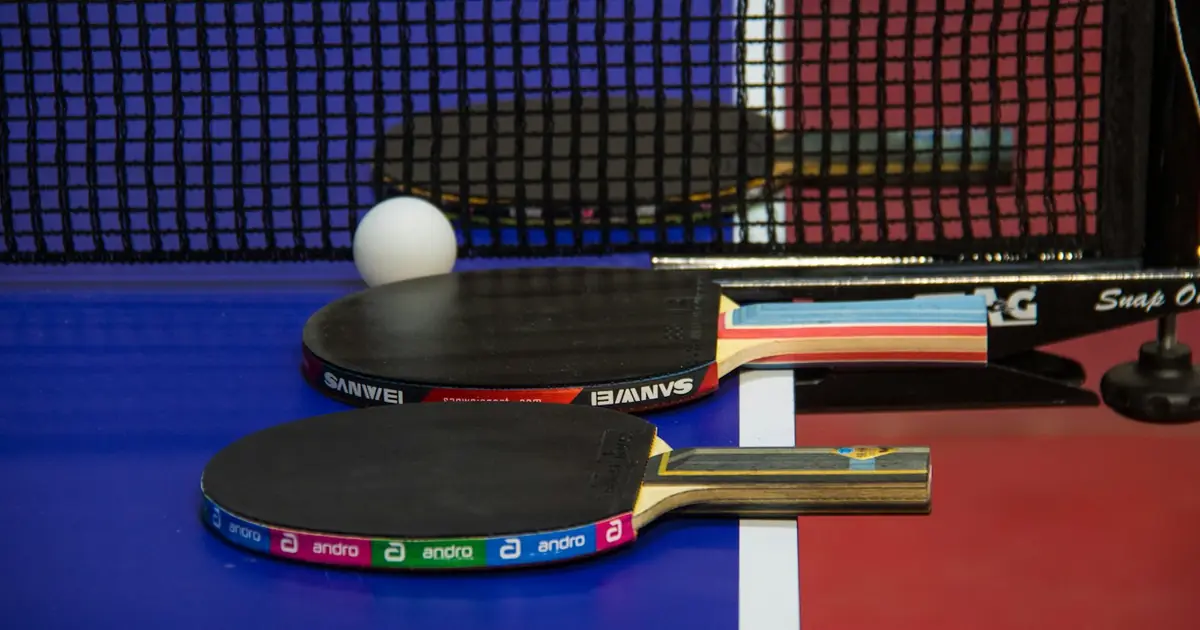
Equipment talk can sound technical, but it all describes a few parts of the racket and how they behave. For a full rundown, see our table tennis equipment overview.
| Term | Meaning |
|---|---|
| Racket / bat / paddle | Three names for the same thing. Racket is the official word; bat is common in the UK and paddle in the US. |
| Blade | The wooden part of the racket, head and handle, without the rubbers. The rules require it to be at least 85% natural wood by thickness. |
| Ply | A layer in the blade. Blades are commonly 5-ply or 7-ply, sometimes with carbon or other fiber layers. |
| Carbon / composite | Fiber layers added to a blade to make it stiffer and faster. |
| ALL / OFF / DEF | Manufacturer labels for allround, offensive and defensive blades, often with a plus or minus to show speed within the class. |
| Rubber | The covering on each side of the blade. One side must be black and the other a bright color clearly different from black and the ball. |
| Sponge | The soft layer under the rubber topsheet that adds speed and spin. The whole covering may be no more than 4 mm thick including adhesive. |
| Inverted (smooth) | The most common rubber: pimples face inward toward the sponge and the smooth surface hits the ball. Generates the most spin. |
| Pips / pimples | Rubber with pimples facing outward. Short pips are flatter and fast; long pips are tall and flexible and return spin in unpredictable ways. |
| Anti-spin (anti) | A very slick inverted rubber that takes most spin off the ball and returns a dead ball. |
| OX | A pimpled rubber with no sponge underneath. |
| Tacky | A sticky topsheet that grips the ball for extra spin, typical of many Chinese rubbers. |
| Hardness | How firm a sponge or blade feels. Harder sponges usually need a stronger stroke but give more control at high power. |
| Speed glue | Solvent-based glue once used to make rubbers faster. It is now banned over health concerns; water-based glues are used instead. |
| Booster | An oil applied to sponges to make them faster and springier. Treating rubbers is not allowed under the ITTF laws, though some players still use it. |
| Hardbat / sandpaper | Hardbat is a short-pips rubber with no sponge, also a retro playing format. Sandpaper rackets are a novelty and are not legal in sanctioned play. |
| Sweet spot | The area of the blade that gives the best feel and response, usually near the center. |
To go deeper, read our guides to table tennis rubber types and table tennis glue, or the history of the sandpaper ping pong paddle. The ball has its own rules too: 40 mm and 2.7 g, as covered in ping pong ball size.
Grips and Playing Styles
Grip names describe how you hold the racket; style names describe how you win points.
| Term | Meaning |
|---|---|
| Shakehand | The most common grip, holding the handle as if shaking hands, with the index finger along the bottom of the blade. |
| Penhold | Holding the racket like a pen, between thumb and index finger. Long associated with players from China, Japan and Korea. |
| Reverse penhold backhand (RPB) | A penhold backhand played with the back face of the racket, letting penholders hit strong topspin on the backhand. |
| Seemiller grip | Named after American player Danny Seemiller: thumb and index finger sit on either side of the base of the blade, and one face is used for both forehand and backhand. |
| Twiddle | Turning the racket in the hand mid-rally to switch which rubber you hit with, popular with players who mix inverted and long pips. |
| Looper | A player who attacks mainly with topspin loops. |
| Chopper | A defensive player who stays back and returns attacks with chops. |
| Blocker | A player who stands close to the table and wins points mostly by blocking. |
| Pusher | A player who pushes most balls and waits for the opponent to miss. |
| Crossover / playing elbow | The spot, usually near the elbow, where a player must choose between forehand and backhand. A favorite target. |
Pictures help with grips, so see our table tennis grips guide for each one in detail.
Slang and Player Talk
Not every word comes from the rulebook. These are the terms you hear at clubs and in garages.
- Cho! A shout of self-encouragement after winning a point, popular among many top players.
- Funny rubber / junk rubber: long pips or anti-spin, so called because the spin that comes back is hard to read.
- Multiball: a training method where a coach feeds ball after ball from a basket.
- Shadow play: practicing strokes and footwork without a ball.
- Loose return: a weak, high or slow ball that invites an attack.
- Hacker: casual-player slang for someone who swings hard with little technique.
- Skunk: a house rule in some casual games, where a game ends early if one player leads by a big margin with zero points against them. It is not in the official rules.
- The apology hand: many players raise a hand after winning a point off a net ball or edge ball, a courtesy for a lucky point.
Putting the Lingo to Use
Start with the basics: let, deuce, push, loop, chop, blade, rubber and shakehand. Those eight words cover most of what you will hear in a first coaching session or a casual match. The spin and equipment terms matter once you start choosing gear or reading your opponent's serve. When you are ready to put the words into practice, our guide on how to play table tennis is the next step, and our tips and tricks hub has more guides like this one.
Frequently Asked Questions
What Is a Let in Ping Pong?
A let is a rally that ends with no point scored and is replayed. The most common one is a serve that clips the net and then lands correctly on the receiver's side. Lets are also called when the receiver was not ready or when play is disturbed, such as a stray ball rolling onto the court.
Why Is It Called Ping Pong?
The name imitates the sound of the celluloid ball hitting the paddle and the table. British maker J. Jaques & Son trademarked Ping-Pong in 1901, and Parker Brothers later held and enforced the name in the US, which is why the sport's official bodies use the name table tennis.
What Is a Table Tennis Bat Called?
The official rules call it a racket. Players also say bat (common in the UK) and paddle (common in the US). The wooden part is the blade, and the coverings glued to each side are the rubbers.
Is It Called Ping Pong or Table Tennis?
Both names describe the same game. Table tennis is the official name used by the ITTF and at the Olympics, while ping pong is the everyday name, especially for casual play in the US. Ping-Pong is also still a registered US trademark.
What Does Deuce Mean in Ping Pong?
Deuce is the nickname for a 10-10 score. From there, players serve one point each in turn and the game continues until someone leads by 2 points. The official laws do not use the word, but players and commentators do.
What Is a Banana Flick?
A banana flick is an attacking backhand shot played over the table against a short ball, usually a short backspin serve. The player brushes the ball with topspin and sidespin, which makes it curve in flight, hence the name.
Sources and References
- Glossary of table tennis, Wikipedia
- Table tennis (history, name, grips), Wikipedia
- It's not ping-pong: Here's the history of the Olympic sport's common nickname (NBC)
- Who Invented Table Tennis? The Jaques of London Story
- Tutti-Frutti Table Tennis Terminology (ITTF)
- ITTF Handbook (Laws of Table Tennis)
- Table Tennis Terminology (All About Table Tennis)