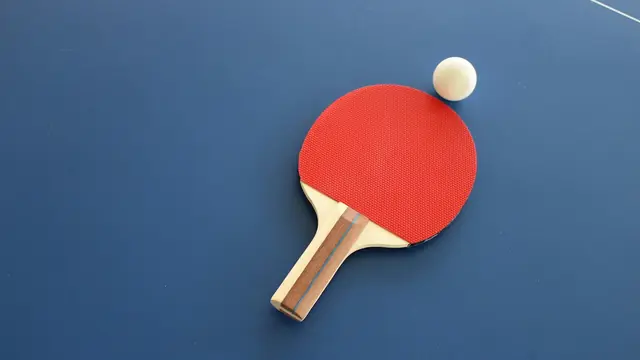
Table Tennis Equipment: The Complete List and Official Specs (2026)
In This Article
Table Tennis Equipment at a Glance
To play table tennis you need four official pieces of equipment: a table, a net assembly, a ball and a racket (paddle) for each player. Add suitable shoes and clothing, and you have everything the rules require. Accessories such as a case, rubber cleaner and ball pickup make the game easier but are optional.
Here is the complete list in the order most people need it:
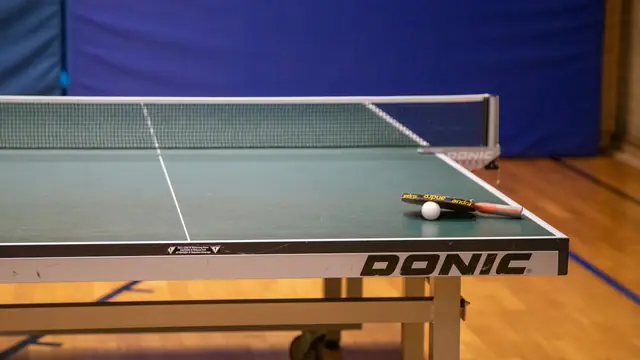
- Table – 2.74 m x 1.525 m, 76 cm high
- Net assembly – net, cord and posts, 15.25 cm high
- Ball – 40 mm, 2.7 g, white or orange plastic
- Racket – blade plus two rubber coverings (one black, one coloured)
- Shoes – indoor court shoes with good grip
- Clothing – shirt and shorts or skirt in a colour different from the ball
- Accessories – case, cleaner, edge tape, towel, ball pickup, robot, scoreboard, table cover
Every official spec below comes from Section 2 of the ITTF Laws of Table Tennis, the rulebook national associations such as USA Table Tennis and Table Tennis England follow. Clothing and venue rules come from the ITTF Regulations for International Competitions.
Quick Facts
- Official equipment items: 4 (table, net assembly, ball, racket)
- Ball size: 40 mm since the 38 mm ball was retired in 2000
- Ball material: plastic, after the switch away from celluloid in 2014
- Blade rule: at least 85% natural wood by thickness
- Rubber colours: black plus red, pink, purple, green or blue
The Official Table Tennis Equipment (ITTF Specs)
These four items are the only equipment the Laws of Table Tennis define in detail. If you are studying the sport for a PE class, this is the list your teacher is looking for.
1. The Table
The table is the biggest purchase and the one item that sets the bounce for everything else. Law 2.1 says the playing surface may be made of any material, as long as a standard ball dropped from 30 cm bounces about 23 cm. That bounce test is why thin, cheap tops feel dead compared with thicker boards.
| Table Spec (Law 2.1) | Official Requirement |
|---|---|
| Length x width | 2.74 m x 1.525 m (9 ft x 5 ft) |
| Height | 76 cm (2 ft 6 in) above the floor |
| Bounce | About 23 cm from a 30 cm drop |
| Surface | Uniformly dark coloured and matt |
| Edge lines | White side and end lines, 2 cm wide |
| Centre line | White, 3 mm wide (used for doubles serves) |
For a full breakdown in feet, inches and room space, see our guide to ping pong table dimensions. Shopping for one? Start with the best ping pong tables, or, if you already own a pool table, look at conversion tops.
2. The Net Assembly
The rules treat the net, its suspension cord and the two supporting posts as one unit called the net assembly. Recreational sets clamp or screw onto the table edge; tournament sets use heavier screw clamps and adjustable tension.
| Net Spec (Law 2.2) | Official Requirement |
|---|---|
| Net height | 15.25 cm (6 in) above the surface along its whole length |
| Post height | 15.25 cm |
| Post position | Outside edge 15.25 cm beyond the side line |
| Bottom edge | As close to the playing surface as possible |
Because the posts sit 15.25 cm outside each side line, a regulation net is a little wider than the table itself. Replacement options are covered in our best ping pong nets guide.
3. The Ball
The ball is the most tightly defined piece of equipment. Competition balls must also be a brand and type currently approved by the ITTF, which is why tournament balls carry an ITTF marking and are sold as 40+ balls.
| Ball Spec (Law 2.3) | Official Requirement |
|---|---|
| Shape and diameter | Spherical, 40 mm |
| Weight | 2.7 g |
| Material | Plastic |
| Colour and finish | White or orange, matt |
Star ratings (1-star, 3-star) are manufacturer grades, not an ITTF category. Our best table tennis balls guide explains what to buy for matches and training, and the upcoming ping pong ball size page covers sizing history in more depth.
4. The Racket (Blade and Rubbers)
A racket has two parts: the wooden blade and the rubber coverings glued to each side. Law 2.4 lets a racket be any size, shape or weight, but the blade must be flat and rigid, and the coverings must be ITTF-authorised for sanctioned play.
| Racket Spec (Law 2.4) | Official Requirement |
|---|---|
| Size, shape, weight | Any, but the blade must be flat and rigid |
| Blade material | At least 85% natural wood by thickness |
| Fibre layers | Each adhesive layer with carbon, glass fibre or compressed paper max 7.5% of thickness or 0.35 mm, whichever is smaller |
| Pimpled rubber (no sponge) | Under 2.05 mm including adhesive |
| Sandwich rubber (sponge + rubber) | Under 4.05 mm including adhesive; pimpled layer max 2.0 mm |
| Colours | One side black, the other a bright colour distinct from black and the ball |
| Coverage | Up to but not beyond the edge of the blade |
| Treatment | No physical, chemical or other treatment of the covering |
Red was the only alternative to black for decades. Since 1 October 2021, the ITTF has also authorised pink, purple, green and blue coverings, so you now see far more colourful rackets at clubs.
Most beginners start with a pre-assembled racket; see our best ping pong paddles. Players building a custom setup choose the parts separately: start with the best table tennis blades, then pair one with the best table tennis rubber for your style.
Clothing and Shoes
For casual play, any comfortable sportswear works. In sanctioned competition, the ITTF Regulations define playing clothing as a short-sleeved or sleeveless shirt, shorts or a skirt (or a one-piece outfit), socks and shoes. Tracksuits are not worn during play unless the referee allows it.
- Colour rule: the main colour of the shirt, shorts or skirt must be clearly different from the ball in use. A white shirt and a white ball is the classic clash.
- Opponents: opposing players must wear shirts that are sufficiently different in colour. If neither will change, the umpire decides by lot.
- Numbers and logos: identification numbers and limited advertising are allowed within set size limits.
Shoes matter more than clothing. Table tennis involves short, explosive side-to-side steps, so a low, light court shoe with a gum-rubber sole is generally a better fit than a cushioned running shoe. Compare options in our best table tennis shoes guide.
Table Tennis Accessories
None of these items are required by the rules, but each solves a real problem. They are also where most of the "supplies" in a club cupboard come from.
| Accessory | What It Does | Who Needs It |
|---|---|---|
| Paddle case | Protects rubber from dust, sunlight and knocks | Anyone with a good racket |
| Rubber cleaner and sponge | Removes sweat and dust to restore grip | Players using smooth inverted rubber |
| Protective film | Covers sticky rubber between sessions | Players with tacky rubbers |
| Edge tape | Protects blade edges from table strikes | Custom racket owners |
| Towel | Dries hands and face; towel breaks come every 6 points in matches | Everyone |
| Ball pickup tube or net | Collects balls without bending | Robot and multiball users, coaches |
| Robot | Feeds balls for solo practice | Players without a regular partner |
| Scoreboard | Keeps score visible for players and spectators | Clubs, schools, leagues |
| Table cover | Shields the top from dust, sun and moisture | Garage and outdoor table owners |
Cleaning makes the biggest difference for the least money; our guide on how to clean a ping pong paddle shows the routine. For solo training, see the best table tennis robots, and for outdoor or garage tables, the best ping pong table covers.
Starter Kits by Level
You do not need to buy everything at once. Here is a sensible order of purchase at three levels.
Budget: Casual and Family Play
- A clamp-on net set and a recreational table or conversion top
- A bundle of pre-assembled recreational paddles
- A large pack of 40+ training balls (they crack and get lost)
Mid-Range: Regular Club Players
- A performance-level pre-assembled racket with ITTF-approved rubber
- A hard case and rubber cleaner to protect it
- Indoor court shoes
- A few 3-star match balls alongside training balls
Premium: Competitive Players
- A custom racket: blade chosen for feel, rubbers chosen for each wing
- Protective film, edge tape and a spare racket
- Table tennis shoes and competition clothing that meets colour rules
- A robot or regular coaching sessions for structured practice
Whatever the level, check that the paddle and balls are in good shape before upgrading the table. A good racket on a decent table beats a poor racket on a great one. For drills to get the most from new gear, see our ping pong practice guide.
Four Starter Items Worth Considering
These four items cover the basics for a player moving beyond recreational play: a racket, practice balls, protection and care.
STIGA Evolution
Best for: Beginners and developing players who want control with some pace
STIGA's all-wood performance-level premade pairs a light 6-ply blade with 2 mm ITTF-approved inverted rubber. It is a sensible first racket for a player moving past recreational paddles.
| Blade | 6-ply light: Ayous, Awan, Kiri |
|---|---|
| Rubber | Smooth inverted, ITTF-approved |
| Sponge | 2 mm |
| Handle | Flared |
| Weight | 159 g (STIGA listing) |
Pros
- All-wood blade is forgiving while you learn strokes
- Light 159 g listed weight
- Tournament-approved rubber
Cons
- Less pace than carbon premades
- Flared handle only
- No case in the box
JOOLA Training 40+ (12, 60 or 120 Pack)
Best for: Robot sessions, multiball and long drills
JOOLA markets its Training 40+ as a seamed ABS ball for high-volume drills, coaching and solo practice. It keeps a home table or club stocked without using up 3-star match balls.
| Use | Training |
|---|---|
| Material | ABS plastic |
| Construction | Seamed |
| Size | 40+ |
| Pack | 12, 60 or 120 balls |
Pros
- Sold in bulk sizes up to 120 balls
- Seamed ABS, the same basic build as match balls
Cons
- A training ball, not a tournament ball
- Bulk boxes take up storage space
Rintifia Hard Shell Ping Pong Paddle Case
Best for: Carrying two paddles and balls without crushing the rubber
A water-resistant hard EVA case for two paddles and balls with a mesh pocket. A rigid shell protects the rubber surface and blade edges in a sports bag.
| Capacity | 2 paddles + balls |
|---|---|
| Shell | Hard EVA |
| Extras | Mesh pocket, water-resistant |
Pros
- Hard shell protects rubber and edges
- Holds two paddles plus balls
Cons
- Bulkier than a soft single-paddle cover
Killerspin Rubber Cleaner Spray Kit
Best for: Keeping smooth rubber grippy between sessions
Killerspin's kit combines a 125 ml spray bottle of rubber cleaner with a two-sided sponge. A light mist per side lifts sweat and dust from smooth rubber.
| Contents | Spray bottle + 2-sided sponge |
|---|---|
| Cleaner size | 125 ml |
| Type | Spray cleaner |
Pros
- Spray gives even coverage with little waste
- Includes a two-sided sponge
Cons
- Smaller bottle than some rivals
Equipment for Clubs and Schools
A club or school room needs more than a table and paddles. The ITTF venue regulations for international events give useful targets, even if a school gym will not meet all of them:
- Playing space: at least 14 m long, 7 m wide and 5 m high per table at international events. Recreational rooms use much less, but more space means fewer interrupted rallies.
- Surrounds (barriers): 50 to 100 cm high, in one dark colour, to stop balls rolling onto other courts.
- Flooring: not light-coloured, shiny or slippery, and resilient. Top events use wood or ITTF-authorised rollable synthetic flooring.
- Lighting: major events call for at least 2000 lux horizontally over the playing surface, so bright, even overhead light helps everywhere.
- Extras: scoreboards, umpire tables, ball baskets, a robot for coaching, and table covers for storage.
Rollaway tables with wheels and locking legs suit schools that share a hall. Our list of places to play ping pong shows how clubs and community venues set up their rooms.
Table Tennis Equipment Summary Table
| Item | Purpose | Official Rule | Our Guide |
|---|---|---|---|
| Table | Playing surface | 2.74 x 1.525 m, 76 cm high, 23 cm bounce | Dimensions |
| Net assembly | Divides the courts | 15.25 cm high, posts 15.25 cm outside | Nets |
| Ball | Object of play | 40 mm, 2.7 g, plastic, white or orange | Balls |
| Racket | Strikes the ball | 85% wood blade; black + bright coloured side | Paddles |
| Blade | Racket core | Flat, rigid, limited fibre layers | Blades |
| Rubber | Grip, speed and spin | ITTF-authorised; max 4.05 mm with sponge | Rubbers |
| Clothing | Comfort and visibility | Main colour different from the ball | See above |
| Shoes | Grip and footwork | Part of playing clothing | Shoes |
| Accessories | Care and practice | None (optional) | Robots |
New to the game itself? Once your equipment is sorted, our guide on how to play table tennis covers the basics, and the ping pong rules page explains scoring and serves.
Frequently Asked Questions
What Are the 4 Main Pieces of Table Tennis Equipment?
The four official items are the table, the net assembly (net, cord and posts), the ball and the racket. Each one is defined in Section 2 of the ITTF Laws of Table Tennis. Shoes and clothing come next, followed by optional accessories.
What Equipment Do You Need to Play Table Tennis at Home?
You need a table (full-size or a conversion top), a net and post set, at least two paddles and a supply of 40 mm balls. A case, a rubber cleaner and indoor court shoes are worthwhile extras once you play regularly.
Is Ping Pong Equipment the Same as Table Tennis Equipment?
Yes. Ping pong and table tennis use the same kinds of tables, nets, balls and paddles. The official rules use the term table tennis and the word racket, while many recreational players say ping pong and paddle.
Can You Wear White in Table Tennis?
ITTF regulations say the main colour of the shirt, shorts or skirt must be clearly different from the colour of the ball in use. Since balls are white or orange, a mostly white shirt clashes with a white ball, so tournaments using white balls generally expect darker or coloured clothing.
What Colour Must Table Tennis Rubbers Be?
One side of the racket must be black and the other a bright colour clearly distinguishable from black and from the ball. Red was the traditional option, and since 1 October 2021 the ITTF has also authorised pink, purple, green and blue.
How Much Wood Must a Table Tennis Blade Contain?
At least 85% of the blade by thickness must be natural wood. Reinforcing layers such as carbon or glass fibre are allowed, but each fibrous adhesive layer may not exceed 7.5% of the total thickness or 0.35 mm, whichever is smaller.