Ding Ning: The Lefty Who Completed the Grand Slam in Rio (2026)
 By Harshwardhan · Updated
In This Article
- Who Is Ding Ning?
- Early Years: From Daqing to the National Team
- Career Timeline
- Ding Ning's Titles and Medals
- London 2012 and the Rio 2016 Revenge
- Rivals and Teammates
- Playing Style: The Squat Serve and the Lefty Angles
- Ding Ning Equipment
- Retirement in 2021
- What Is Ding Ning Doing Now?
- Fun Facts About Ding Ning
- Frequently Asked Questions
Who Is Ding Ning?
Ding Ning is a retired Chinese table tennis player and one of the most decorated women in the sport's history. A left-handed attacker, she won the World Championship singles title three times (2011, 2015, 2017), the World Cup three times and Olympic singles gold at Rio 2016, which completed her career Grand Slam.
She spent 53 months as world No. 1 across four separate spells and earned the nickname "Queen of Hearts." Ding retired in September 2021 to study at Peking University, and since 2025 she has led the Beijing sports school where her own career began.
Quick Facts
- Born: June 20, 1990, Daqing, Heilongjiang, China
- Height: 1.71 m (5 ft 7 in)
- Plays: Left-handed, shakehand grip
- Nickname: "Queen of Hearts"
- Time at world No. 1: 53 months, in four spells
- Olympic medals: 3 golds, 1 silver
- World singles titles: 3 (2011, 2015, 2017)
- World Cup singles titles: 3 (2011, 2014, 2018)
- Grand Slam: Completed at Rio 2016
- Retired: September 2021
- Current role (as of late 2025): Principal, Xiannongtan Sports School, Beijing
Early Years: From Daqing to the National Team
Ding was born in the oil city of Daqing in northeast China. At age 10 she started training at Beijing's Xiannongtan Sports School, a state sports school founded in 1956 that develops athletes in table tennis and several other sports. She entered China's national youth setup in 2003 and was called up to the national team in 2005.
That same year she won the World Junior Championships singles title, the first big sign of what was coming. By 2009 she had won singles, doubles and team gold at the Asian Championships and reached the doubles final at the World Championships. China's famous depth meant she had to beat teammates such as Li Xiaoxia and Liu Shiwen just to get selected, a system we explain in why China is so good at table tennis.
Career Timeline
| Year | Milestone |
|---|---|
| 2005 | World Junior Championships singles champion; national team call-up |
| 2009 | Asian Championships singles, doubles and team gold |
| 2011 | First world singles title (Rotterdam) and first World Cup singles title (Singapore) |
| 2012 | London Olympics: team gold, singles silver; world team title (Dortmund) |
| 2014 | Second World Cup singles title (Linz); world team title (Tokyo); Asian Cup winner |
| 2015 | Second world singles title (Suzhou), beating Liu Shiwen 4-3; ITTF World Tour Grand Finals winner (Lisbon) |
| 2016 | Rio Olympics: singles and team gold, completing the Grand Slam; China's flag bearer at the closing ceremony |
| 2017 | Third world singles title (Düsseldorf), beating Zhu Yuling 4-2, plus women's doubles gold |
| 2018 | Third World Cup singles title (Chengdu); world team title (Halmstad) |
| 2019 | World singles and mixed doubles bronze (Budapest); back to world No. 1 in March |
| 2021 | Retirement announced in September |
Ding Ning's Titles and Medals
The table below lists her major senior gold medals. It leaves out her many silver and bronze medals, including five World Championship silvers and three bronzes.
| Competition | Gold Medals | Years |
|---|---|---|
| Olympic Games (singles) | 1 | 2016 (silver in 2012) |
| Olympic Games (team) | 2 | 2012, 2016 |
| World Championships (singles) | 3 | 2011, 2015, 2017 |
| World Championships (doubles) | 1 | 2017 |
| World Team Championships | 4 | 2012, 2014, 2016, 2018 |
| World Cup (singles) | 3 | 2011, 2014, 2018 |
| World Cup (team) | 7 | 2009, 2010, 2011, 2013, 2015, 2018, 2019 |
| Asian Games (team) | 2 | 2010, 2014 |
| Asian Championships (singles) | 1 | 2009 |
| World Junior Championships (singles) | 1 | 2005 |
Her three world singles crowns put her level with Deng Yaping and Wang Nan among Chinese women. On the ITTF Pro Tour she also collected a long list of singles and doubles titles. For a wider view of the event, see our guide to the table tennis World Championships.
London 2012 and the Rio 2016 Revenge
Ding's Olympic story is really one long rivalry with her teammate Li Xiaoxia, played out across two finals.
London 2012: Silver After a Tense Final
Ding arrived in London as the reigning world champion but lost the singles final to Li. During the match she received several penalty points from the umpire, a moment that unsettled her and became one of the talking points of the tournament. She still left London with team gold.
Rio 2016: The Grand Slam
Four years later the same two players met again in the Olympic final, and this time Ding won 4-3. It was a swinging match: she took the first game after leading 6-1, Li fought back to lead 3-2 after saving her way through the fifth, and Ding leveled before racing to a 10-5 lead in the decider. Li saved two match points, Ding called a time-out, and she won the next point to take gold.
The ITTF noted how she leaned on her trademark squat serve at the crucial moments. Afterward she said she could not believe she was Olympic champion. The win made her the fifth Chinese woman to complete the career Grand Slam (Olympic, world and World Cup singles titles). She then helped China retain the team title and carried the national flag at the closing ceremony. More on the Games in our guide to table tennis at the Olympics.
Rivals and Teammates
Ding's era of the Chinese women's team was unusually deep, and her toughest matches were often against teammates:
- Li Xiaoxia: her Olympic final opponent in both London and Rio.
- Liu Shiwen: beaten 4-3 in the 2015 world final in Suzhou, a final that went the full seven games.
- Zhu Yuling: beaten 4-2 in the 2017 world final in Düsseldorf, the last of Ding's world titles.
Today's leaders, such as Sun Yingsha, came through the same system as Ding was winning her last major titles. See how they all compare in our ranking of the best female table tennis players.
Playing Style: The Squat Serve and the Lefty Angles
Ding was a left-handed shakehand attacker. The most recognizable part of her game was the serve:
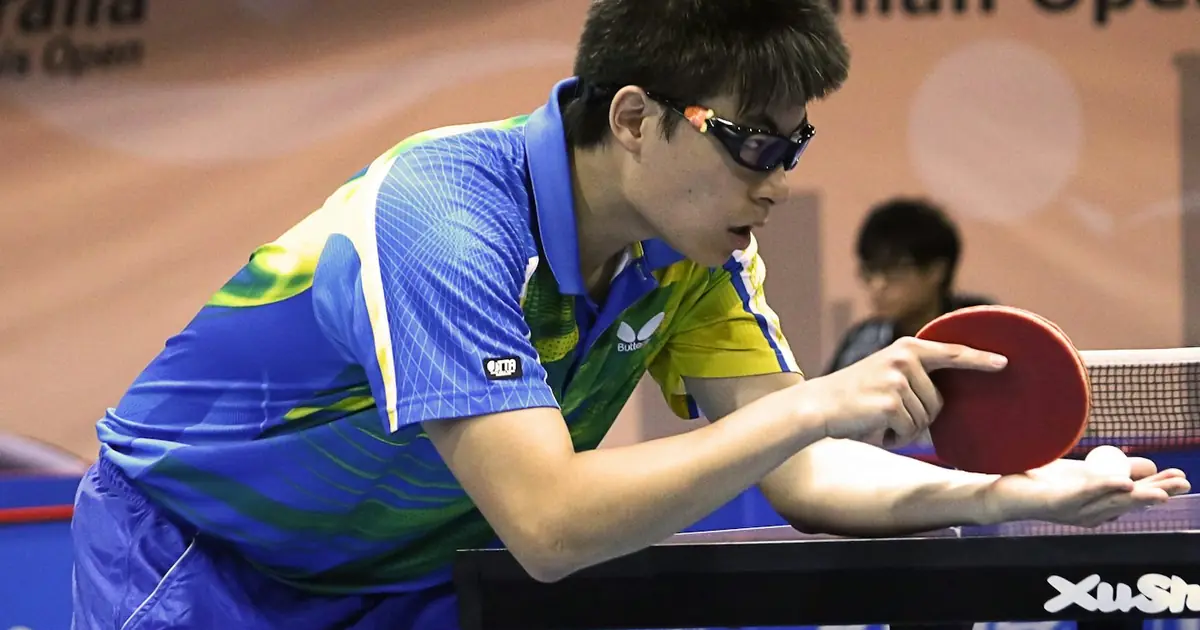
- Squat serve: she dropped low at the table to serve, a technique that makes the contact point and spin harder to read. The ITTF called it her "trademark" and noted she went back to it under pressure in the Rio final.
- Forehand "banana" return: the ITTF also highlighted an unusual banana-style return of serve played with her forehand. The banana flick is usually a backhand shot, so this was a distinctive variation.
- Left-handed angles: as a lefty, her crosscourt shots go to a right-hander's backhand, which changes the usual patterns of play.
Club players can borrow the main idea without copying the technique: vary serve motions and contact points so opponents cannot read the spin. Our guide on how to serve in ping pong covers the basics, and the same principle applies whichever grip you use.
Ding Ning Equipment
Ding's full match setup has not been officially published. What can be said is that she is closely associated with the Chinese brand DHS, which has sold Ding Ning-branded equipment, including a blade marketed as the Hurricane Ning and a version of its Hurricane 3 rubber carrying her name. Like most Chinese national team players, she is reported to have used a tacky Hurricane 3-type rubber on the forehand. Our DHS Hurricane 3 review explains why that rubber is so popular with Chinese players.
Retirement in 2021
In September 2021, aged 31, Ding announced on social media that she was retiring after 26 years in the sport. Her post read: "Today marks my first day as a grad student at Peking University!" She added that from then on she was "no longer 'Ding Ning the athlete' but 'Ding Ning, the student.'"
What Is Ding Ning Doing Now?
Ding has moved steadily into education and sports leadership:
- 2023: graduated with a master's degree from Peking University and became a lecturer in its Department of PE.
- 2024: elected chair of the Olympic Council of Asia Athletes' Committee.
- October 2025: appointed principal of Xiannongtan Sports School in Beijing, the school where she trained from age 10.
- November 2025: attended China's 15th National Games as a team official rather than a competitor, and was seen cheering her former teammate Ma Long as Beijing won the men's team final.
In a late-2025 interview she said the school would focus on talent development and the psychological education of young athletes. As of November 2026, the most recent reliable reports still list her as the school's principal; no newer change of role was found, so treat this as the latest known position.
Fun Facts About Ding Ning
- She competed at four straight China National Games, from 2005 to 2017.
- Her Grand Slam was completed only 11 years after her world junior title.
- She served as China's flag bearer at the Rio 2016 closing ceremony.
- She returned to world No. 1 in March 2019, eight years after winning her first world title.
Want to see where she ranks among the all-time greats, men and women included? Our list of the best ping pong players puts her career in context.
Frequently Asked Questions
Is Ding Ning Retired?
Yes. Ding Ning announced her retirement from competitive table tennis in September 2021, after 26 years in the sport, and began a master's degree in physical education at Peking University.
What Is Ding Ning Doing Now?
As of the latest reports (late 2025), she is principal of Beijing's Xiannongtan Sports School, the school where she started training at age 10. She also lectured in Peking University's Department of PE after graduating in 2023 and was elected chair of the Olympic Council of Asia Athletes' Committee in 2024.
How Many World Titles Did Ding Ning Win?
She won three World Championship singles titles (2011, 2015 and 2017) and eight World Championship gold medals in total, including the 2017 women's doubles and four team titles (2012, 2014, 2016 and 2018).
Did Ding Ning Win the Grand Slam?
Yes. Her Rio 2016 Olympic singles gold, added to her world and World Cup singles titles, completed the career Grand Slam. She was the fifth Chinese woman to do so.
Is Ding Ning Left-Handed?
Yes. Ding Ning is a left-handed player who used the shakehand grip, not penhold.
How Old Is Ding Ning?
Ding Ning was born on June 20, 1990, in Daqing, Heilongjiang, China, so she is 36 as of November 2026.