Jan-Ove Waldner: How the Mozart of Table Tennis Beat China (2026)
In This Article
Who Is Jan-Ove Waldner?
Known as "the Mozart of table tennis" in the West and the "Evergreen Tree" in China, Waldner competed at the international elite level for more than thirty years. He led Sweden through a golden era in which a small country repeatedly beat the Chinese system, and he still ranks third in our list of the best ping pong players of all time.
Quick Facts
- Full name: Jan-Ove Waldner (often "J-O")
- Born: 3 October 1965, Stockholm, Sweden
- Grip: Shakehand
- Olympic medals: Gold (1992), silver (2000), both in men's singles
- World Championship golds: 6 (2 singles, 4 team)
- Grand Slam: First man ever to complete it (1992)
- Nicknames: Mozart of Table Tennis, J-O, Lao Wa ("Old Wa"), Evergreen Tree
- Retired: Officially in February 2016, at 50
Early Life and the Road to the Top
Waldner grew up in Stockholm and, according to Megaspin, started playing at around age six at a local club with his older brother. STIGA says it sponsored him from the age of seven, and he later became one of Donic's best-known players. His official site describes him as an infant prodigy with unusual ball control, raised by a family that valued the joy of playing over money.
He rose fast. At 16 he reached the 1982 European Championships singles final, losing to his compatriot Mikael Appelgren. He won his first Swedish national title in 1983, and that same year, at 18, reached the World Cup final, a record for the youngest finalist that stood for 36 years until Tomokazu Harimoto broke it in 2019, according to the ITTF.
A formative chapter came in China. Waldner has said that training there as a young player showed him what it really takes to become a world champion, an experience that shaped his approach to the sport.
The Golden Era: Sweden vs China
In the 1980s and 1990s, Sweden was the one nation that could consistently challenge China. The core of that team was Waldner, Jörgen Persson, Mikael Appelgren and Erik Lindh, later joined by Peter Karlsson. You can read how this era fits into the wider story of the sport in our history of table tennis.
- 1989, Dortmund: Sweden beat China to win the Swaythling Cup (the men's world team title), and Waldner won the singles. His official site calls it the start of "the days of glory."
- 1991, Chiba: Sweden retained the team title, and the singles final was an all-Swedish affair that Persson won against Waldner.
- 1993, Gothenburg: A third straight team world title, this time on home soil.
- 2000, Kuala Lumpur: Sweden beat China again in the team final. The ITTF credits Waldner's reading of the match order: after beating Liu Guoliang, he told Persson to get ready, correctly predicting Persson's next opponent.
The rivalry within the Swedish team mattered too. Appelgren beat a teenage Waldner for the 1982 European title, and Persson beat him for the 1991 world crown, yet the three won major team and doubles titles together.
Olympic Career: Gold at 26, Silver at 34
Table tennis joined the Olympics at Seoul 1988, and Waldner played the first five Olympic tournaments from 1988 to 2004. For the full medal picture, see our guide to table tennis at the Olympics.
| Games | Men's Singles Result | Notes |
|---|---|---|
| Seoul 1988 | Quarterfinal | Lost in the last eight, per the ITTF |
| Barcelona 1992 | Gold | Beat Jean-Philippe Gatien 21-10, 21-18, 25-23 in the final |
| Atlanta 1996 | No medal | Medals went to Liu Guoliang, Wang Tao and Jörg Rosskopf |
| Sydney 2000 | Silver | Lost the final 3-2 to Kong Linghui |
| Athens 2004 | Fourth | Beat Timo Boll in the quarterfinal at 38; lost the semifinal 4-1 to Ryu Seung-min and missed bronze |
Barcelona was the high point. Waldner's gold is still the only Olympic men's singles title won by a player from outside Asia, and it completed his Grand Slam. Athens 2004 showed his staying power: Olympics.com notes he reached the semifinals after about eight months out with a foot injury, and his quarterfinal win came against a German who would become a European legend himself (see our Timo Boll profile).
Playing Style: Serve, Touch and Tactics
Waldner played with a shakehand grip and an all-round attacking game built on control rather than pure power. The European Table Tennis Hall of Fame calls him a supreme artist and a master of service and ball control who rose to big occasions.
- Serve: His serves were famously varied and deceptive. Waldner himself told Olympics.com his style included "good serves that could give me some easy points." Coaching site PingSkills even teaches his fast serve down the line; our guide on how to serve in ping pong covers the basics behind it.
- Touch and placement: He was known for soft blocks, sudden changes of pace and placement that pulled opponents out of position.
- Tactical reading: The 2000 team final is the best-documented example of how far ahead he could think.
- Temperament: The ITTF notes he could be inconsistent when not in the mood, finishing 15th at the 1989 World Cup before winning the event a year later.
Why China Calls Him the Evergreen Tree
Few foreign athletes are as celebrated in China as Waldner. Chinese fans call him 老瓦 (Lǎo Wǎ, "Old Wa") and 常青树 (Cháng Qīng Shù, the "Evergreen Tree"), a nod to how long he stayed competitive against their best players. By the end of his career, some young Chinese players he faced had been coached by men he had beaten in the 1990s.
His fame is well documented. A Chinese source cited by Wikipedia says he was more recognizable in China in the 1990s than U.S. President Bill Clinton, and Waldner told Olympics.com: "Bill Clinton and I were the most famous Westerners in China." According to Donic, China issued a stamp in his honor in 2013, the first for a foreigner. Waldner is also the principal owner of a Swedish company named CSC Chang Qing Shu in China AB, borrowing his Chinese nickname.
Equipment: Waldner and Donic
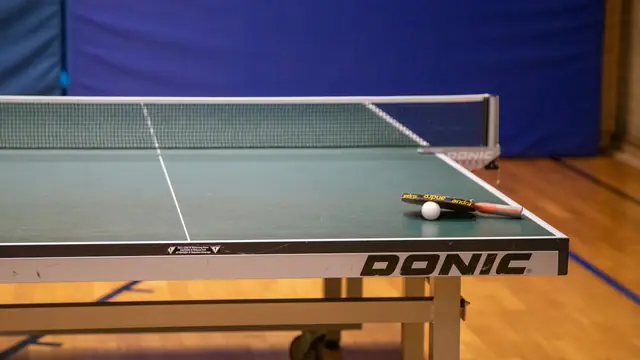
Donic says it has been Waldner's partner since his childhood and that he won all of his major titles with its equipment. The German brand still sells blades bearing his name, including the Waldner Offensiv and the Waldner OFF World Champion 89.
| Donic Waldner Offensiv | Manufacturer Specs |
|---|---|
| Construction | 5-ply wood: ayous core, Scandinavian pine, limba outer veneers |
| Class | ALL+ / OFF- |
| Weight | Under 80 g |
| Speed, control, elasticity | Medium |
| History | Described as a re-release of the blade he used for 1992 Olympic and 1997 world singles gold |
A medium-speed wooden blade may surprise anyone used to today's carbon frames, which shows how much of his game came from touch. For modern options, see our best table tennis blades guide, or compare with what a current champion uses in our Ma Long equipment breakdown.
Key Titles
| Competition | Gold Medals | Years |
|---|---|---|
| Olympic Games (singles) | 1 | 1992 (plus silver in 2000) |
| World Championships (singles) | 2 | 1989, 1997 |
| World Championships (team) | 4 | 1989, 1991, 1993, 2000 |
| World Cup (singles) | 1 | 1990 |
| European Championships (singles) | 1 | 1996 |
| European Championships (doubles) | 3 | 1986, 1988, 1996 |
| European Championships (team) | 7 | 1986, 1988, 1990, 1992, 1996, 2000, 2002 |
| Europe Top 12 | 7 | 1984, 1986, 1988, 1989, 1993, 1995, 1996 |
| Swedish Championships (singles) | 9 | 1983 to 2010 |
Career Timeline
| Year | Milestone |
|---|---|
| 1965 | Born in Stockholm on 3 October |
| 1982 | European singles runner-up at 16 |
| 1983 | First Swedish singles title; youngest-ever World Cup finalist at 18 |
| 1989 | World singles and team champion in Dortmund |
| 1990 | World Cup champion in Chiba |
| 1992 | Olympic gold in Barcelona; first man to complete the Grand Slam; Svenska Dagbladet Gold Medal |
| 1996 | European singles champion in Bratislava |
| 1997 | Second world singles title in Manchester |
| 2000 | Olympic silver in Sydney; world team gold in Kuala Lumpur |
| 2003 | Inducted into the ITTF Hall of Fame |
| 2004 | Olympic semifinalist in Athens at 38 |
| 2010 | Ninth Swedish singles title, aged 44 |
| 2012 | Leaves Fulda-Maberzell and the German Bundesliga at 46 |
| 2016 | Final league match and official retirement at 50 |
- His World Cup final appearance at 18 was the youngest on record for 36 years.
- Six men have completed the career Grand Slam. Waldner was the first, and the other five (Liu Guoliang, Kong Linghui, Zhang Jike, Ma Long and Fan Zhendong) are all Chinese.
- He won Swedish singles titles 27 years apart, in 1983 and 2010.
- He played at the first five Olympic table tennis tournaments, as did teammate Jörgen Persson.
Legacy
Waldner proved that a player from outside China could beat the world's strongest system, not once but across three decades. His Grand Slam, his lone non-Asian Olympic singles gold and Sweden's run of world team titles remain landmarks of the sport. Just as lasting is his style: creative serves, soft touch and tactical thinking that coaches still teach. In Sweden he is a sporting icon, and in China, more than two decades after his peak, the Evergreen Tree is still one of the most famous foreign athletes of all.
Frequently Asked Questions
Why Is Jan-Ove Waldner Called the Mozart of Table Tennis?
The nickname, used in New York Times and International Herald Tribune coverage, refers to his creativity, touch and ball control. He was known for winning points in unusual ways rather than through raw power alone.
Did Jan-Ove Waldner Win an Olympic Gold Medal?
Yes. He won men's singles gold at Barcelona 1992, beating France's Jean-Philippe Gatien in the final. He added a singles silver at Sydney 2000 and remains the only player from outside Asia to win Olympic men's singles gold.
How Many World Championships Did Waldner Win?
He won six World Championship gold medals: men's singles in 1989 and 1997, and team titles with Sweden in 1989, 1991, 1993 and 2000. He also won the 1990 World Cup.
Why Is Waldner So Famous in China?
He beat China's best players for more than a decade, and Chinese fans admired his style and longevity. They nicknamed him Lao Wa (Old Wa) and the Evergreen Tree, and according to Donic, China issued a stamp in his honor in 2013.
When Did Jan-Ove Waldner Retire?
He left the German Bundesliga in May 2012, at 46, and officially retired as a player in February 2016 after a final Swedish league match for Ängby/Spårvägen, when he was 50.
What Blade Did Jan-Ove Waldner Use?
He played with Donic equipment throughout his major-title career. Donic's current Waldner Offensiv blade is described by the company as a re-release of the five-ply wooden blade he used to win the 1992 Olympics and the 1997 World Championships.
Sources and References
- Jan-Ove Waldner - Wikipedia
- Jan-Ove Waldner: The Mozart of Table Tennis - ITTF
- Winning Gold at Barcelona 1992 Gave 'Evergreen Tree' Waldner 'Presidential' Fame - Olympics.com
- Jan-Ove Waldner - European Table Tennis Hall of Fame
- Jan-Ove Waldner - DONIC Champions
- DONIC Waldner Offensiv Blade - DONIC
- Ryu's Speed Too Much for Waldner - Megaspin
- Happy Birthday Waldner - Megaspin
- J-O Waldner Career - jo-waldner.com