Concrete Ping Pong Tables: Specs, Play, Installation and Options (2026)
 By Harshwardhan · Updated
In This Article
- What Is a Concrete Ping Pong Table?
- How Concrete Tables Are Made
- Who Makes Them: Verified Models
- Concrete vs Steel vs Folding Outdoor Tables
- How Do Concrete Tables Play?
- Installation: Base, Delivery and Permits
- Maintenance and Weather
- Vandal Resistance for Parks and Schools
- Where You Will Find Public Concrete Tables
- Can You Build a DIY Concrete Table?
- Is a Concrete Ping Pong Table Right for You?
- Frequently Asked Questions
What Is a Concrete Ping Pong Table?
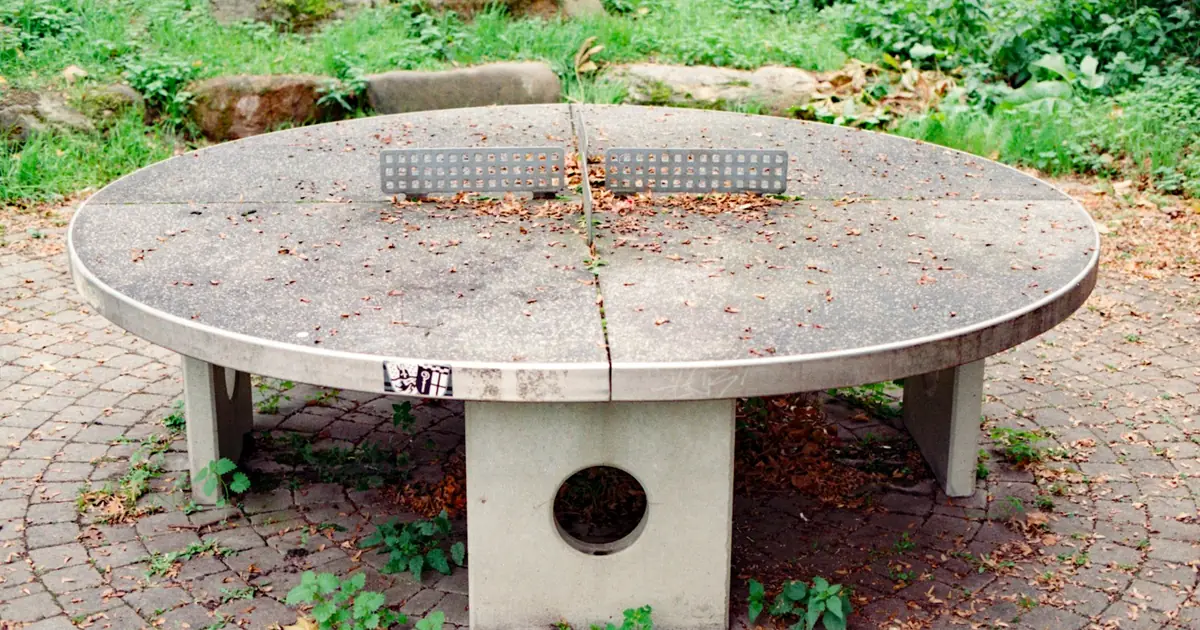
A concrete ping pong table is a permanent outdoor table cast from steel-reinforced concrete, built to stay in one place for decades. Most weigh around a ton or more, need machinery or a team to install, and shrug off rain, snow, sun and rough treatment. That makes them the standard choice for parks, schoolyards and public plazas, and an occasional choice for backyards where the table never needs to move.
They are not the only permanent option. Galvanized steel tables with thick resin or composite tops do a similar job at a fraction of the weight. Below you will find real manufacturer specs, how these tables play, what installation involves, and when a lighter outdoor table makes more sense.
Quick Facts
- Typical weight: about 2,000–2,700 lb for full-size concrete models
- Standard size: 9 x 5 ft (274 x 152.5 cm), 30 in (76 cm) high
- Top thickness: 50 mm (DONIC Rock) to 2 5/8 in (Stone Age Uptown)
- Nets: fixed steel, aluminum or cast concrete
- Best for: parks, schools, campuses, apartment complexes and permanent backyard setups
How Concrete Tables Are Made
Manufacturers pour concrete into precision molds around steel reinforcement, then cure, finish and seal the parts. Stone Age Concrete Games, for example, casts its Uptown table from 5000 PSI concrete with welded wire reinforcing in the top, rebar in the legs and FORTA FERRO fiber reinforcement in both. The top is integrally colored, polished to a finish its spec sheet compares to a smooth concrete countertop, and printed with regulation lines. Edges are cast with a 3/8 in radius so stray hands and hips do not meet a sharp corner.
Some designer tables use glass fiber reinforced concrete (GFRC), which Concrete Network notes can cut weight by 50% or more while keeping a thin, smooth top. Finishes range from polished and matte to lightly sandblasted, with custom colors and logos available from smaller makers.
Who Makes Them: Verified Models
Only a handful of companies publish full specs for concrete and other permanent tables. These are the ones with published details:
| Model | Build | Weight | Top | Net | Warranty |
|---|---|---|---|---|---|
| Stone Age Uptown (US) | Precast reinforced concrete, steel runners | About 2,650 lb | 2 5/8 in solid concrete, polished | 3/8 in powder-coated steel (stainless optional) | 3 years, limited |
| DONIC Rock (Germany) | Solid concrete, dyed anthracite | 945 kg (about 2,080 lb) | 50 mm concrete, smooth steel-formwork finish | Aluminum, permanently mounted | 10 years |
| Cornilleau PARK (France) | Galvanized steel and Aluzinc frame | 162 kg (about 357 lb) | 9 mm laminated resin, anti-glare | Fixed galvanized steel, tamper-proof | 10 years |
| KETTLER Eden (Germany) | Hot-dip galvanized steel frame and legs | 280 lb | 10 mm KETT-TEC10 composite | 4 mm galvanized steel | 10 years top, 3 years other parts |
Stone Age, based in the US, also sells cantilever, dining and round designs. DONIC offers the Rock with angular or rounded corners and certifies it to EN 14468-1 class D for hobby play. Cornilleau rates the PARK to carry loads up to 1,600 kg and lists it as accessible for wheelchair users. KETTLER's Eden ships with anchor bolts and is pitched at parks, campgrounds and homes. For more on the brand's folding range, see our KETTLER ping pong tables guide.
Prices for these tables vary widely and many concrete makers quote on request. Concrete Network puts mid-range concrete tables at roughly $2,000 to $4,000 and high-end handcrafted pieces at $10,000 or more. Steel park tables usually sit in the premium tier of outdoor tables; our ping pong table prices guide covers the wider market.
Concrete vs Steel vs Folding Outdoor Tables
| Factor | Concrete | Permanent Steel (Resin Top) | Folding Outdoor (Aluminum Composite) |
|---|---|---|---|
| Weight | About 2,000–2,700 lb | About 280–360 lb | Often under 200 lb |
| Moves? | No, permanent | Bolted down; can be relocated | Folds and rolls away |
| Vandal resistance | Very high | High (fixed nets, galvanized parts) | Low; best in private or supervised spaces |
| Weather | Left out year-round | Left out year-round | Weatherproof, but a cover is recommended |
| Installation | Machinery or a crew, level base | Small crew, anchor bolts | One or two people |
| Price tier | Premium to luxury | Premium | Budget to mid-range |
| Best for | Parks, plazas, schools | Parks, campgrounds, campuses, homes | Patios, decks, garages |
If your table lives on a private patio and you want the freedom to fold it away, a folding model from our best outdoor ping pong tables list is far simpler and cheaper.
How Do Concrete Tables Play?
The Laws of Table Tennis require a playing surface that gives a uniform bounce of about 23 cm when a standard ball is dropped onto it from 30 cm. Most concrete tables are not built or certified to tournament standard, so treat them as recreational equipment.
That said, a smooth, well-cast top plays better than many people expect. DONIC describes the Rock's steel-formwork surface as giving an even, high bounce, and Concrete Network reports that ball bounce is generally good. The bigger differences are elsewhere:
- Friction: sealed concrete and resin tops can feel different from painted indoor wood, which affects how spin grips.
- Rounded corners: safety radiuses and rounded-corner models trim a sliver of playing area at the edges.
- Debris: Stone Age notes that even small particles can change the ball's path, so players wipe the top before every game.
- Wind and sun: these affect every outdoor table, whatever it is made of. Heavier outdoor balls help; see our best table tennis balls picks.
Installation: Base, Delivery and Permits

Because a cement table cannot be repositioned easily, planning the site matters more than anything else.
- Pick the spot. Table Tennis England recommends a total playing area of 8 x 4 m with at least 3 m of clear height. Visible, well-lit, busy locations get more use and suffer less vandalism; very windy spots play poorly.
- Prepare the base. Stone Age says its tables install on flat hard surfaces such as concrete or asphalt without sub-grade work, while grass needs compacted gravel footers under the legs. DONIC asks for level, stabilized ground and a load-bearing foundation under the supports on soft ground. If you pour a pad on grass, Table Tennis England suggests extending it 2 m beyond each end and 1 m beyond each side.
- Plan delivery. DONIC ships the Rock in parts on two pallets and says assembly takes 1 to 1.5 hours with at least four people. Stone Age bolts its tables together with hand tools in about 1 to 2 hours. Pieces this heavy still need truck access and suitable lifting equipment, so check the route from road to site.
- Anchor if needed. Stone Age fits the center leg for an optional bolt-down to concrete. Steel tables such as the Cornilleau PARK and KETTLER Eden are designed to be bolted or anchored.
- Get permission and insurance. For public or shared land, secure approval from the landowner or local authority first. Table Tennis England also advises checking public liability insurance and running regular risk assessments.
Maintenance and Weather
Concrete needs very little care, but not zero. Stone Age's care guide recommends:
- Brushing or wiping off dust, leaves and sand before play.
- Hosing the table down now and then, with a mild non-corrosive soap if needed.
- Inspecting the concrete every year and resealing with a quality polyurethane sealer when needed; its warranty notes call for evaluation at least every 2 years.
- Touching up scratches on powder-coated steel parts yearly to prevent rust.
Concrete Network adds that concrete tables resist warping, mold and mildew and clean up with mild soap and water. Steel park tables are similar: Table Tennis England says marks on Cornilleau PARK tables wash off with soapy water, and graffiti can be removed with acetone. For general cleaning methods, see how to clean a ping pong table.
Vandal Resistance for Parks and Schools
Permanent tables are designed for unsupervised spaces. Stone Age uses pin-in-hex vandal-resistant bolts and an anti-graffiti sealer, though its warranty still excludes intentional vandalism. Cornilleau's PARK has a tamper-proof steel net and corner protectors. Weight is a defense in itself: a table approaching 2,700 lb is not going anywhere. Table Tennis England reports that outdoor tables are generally well respected, quoting South Norfolk District Council: "We've had so little vandalism, it's been amazing."
Where You Will Find Public Concrete Tables
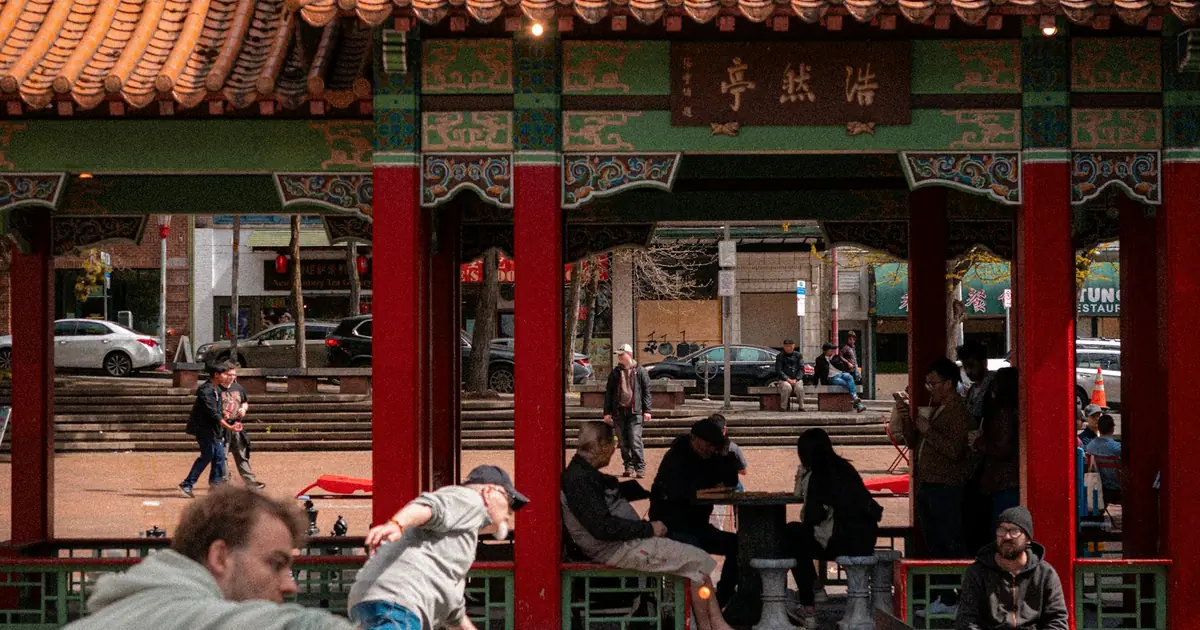
Permanent tables are now a familiar sight in city parks. A well-documented early example came in New York: in March 2011, local company Henge donated a permanent concrete table to Tompkins Square Park, dedicated to longtime park supervisor Harry Greenberg. Core77 reported that Henge's tables weighed 2,300 to 2,800 lb, were made in Michigan, and that Roosevelt Island and Fort Tryon Park had placed orders through NYC Parks.
Many parks, campuses and plazas now offer free outdoor play, but not every table is concrete. Our guide to places to play ping pong covers how to find public tables near you.
Can You Build a DIY Concrete Table?
Yes, but it is a serious project. A homemade cement table needs a sturdy, perfectly level mold, steel reinforcement, a base strong enough to carry the slab, and a smooth, flat finish. Any warp or ridge shows up immediately in the bounce, and a full-size slab needs several people or equipment to move. Use the official ping pong table dimensions for the mold, and compare other build approaches in our DIY ping pong table guide.
Is a Concrete Ping Pong Table Right for You?
Choose concrete if the table will live outdoors permanently, in a public or semi-public space, and must survive years of weather and rough use with minimal care. Choose a permanent steel table if you want similar durability at a fraction of the weight and an easier install. Choose a folding outdoor table if the table is for your own backyard and you value portability and a lower price over permanence.
Frequently Asked Questions
How Much Does a Concrete Ping Pong Table Weigh?
Usually between about 2,000 and 2,700 lb. DONIC lists its Rock table at 945 kg (about 2,080 lb), and Stone Age lists its Uptown table at approximately 2,650 lb.
Do Concrete Ping Pong Tables Bounce Well?
They play well enough for casual and community games, and smooth cast tops give an even bounce. They are not built to tournament standard, and serious players will notice the difference from a thick indoor table.
Can a Concrete Table Be Left Outside All Year?
Yes. That is the main reason to buy one. Rain, snow and sun do not warp concrete, though manufacturers recommend inspecting and resealing the surface periodically and touching up painted steel parts.
Does a Concrete Ping Pong Table Need a Foundation?
Not always. Stone Age and DONIC say their tables can stand on level asphalt or concrete without extra groundwork, but grass and soft ground need a gravel footing or load-bearing foundation under the legs.
Are Concrete Tables Regulation Size?
Most are. Full-size models from Stone Age and DONIC follow the standard 9 x 5 ft (274 x 152.5 cm) top at 30 in (76 cm) high, but round, trapezoid and rounded-corner designs change the playing area.